You are running ads. You are spending money. But the leads are just not coming in, or maybe they are coming in, but they are low quality and never turn into paying customers.
This is one of the most frustrating situations a business owner can face. Whether you are running a small business in Texas or managing marketing campaigns across multiple US cities, the pain feels the same. You put your budget into Google Ads or Meta Ads, and the results feel random at best and completely wasteful at worst.
Here is the truth. Successful lead generation is not about spending more money on ads. It is about having the right message, for the right person, at the right moment in their buying journey. Effective Google and Meta Ads services help businesses guide potential customers from curiosity to confident action, one step at a time.
This guide breaks down that exact strategy so you can build campaigns that actually deliver results.
Why Understanding Your Audience’s Buying Stage Changes Everything
Not every person who sees your ad is ready to buy. Some people are just discovering they have a problem. Others are actively comparing different options. And a smaller group is ready to take action right now.
When you treat all three of these groups the same way, your ads underperform. You end up showing sales pitches to people who are still in research mode, and you waste budget on broad audiences when you should be closing warm leads.
The smartest advertisers split their strategy into three stages based on where the customer is in their decision process. The first stage focuses on building awareness. The second stage focuses on building trust and interest. The third stage focuses on converting that interest into a real lead or sale. When your Google and Meta campaigns are built around this thinking, everything starts working better together.
Stage One: Getting in Front of the Right People for the First Time
Reaching Cold Audiences Who Do Not Know You Yet
At this first stage, your job is not to sell. Your job is simply to get noticed by the right people and make a strong first impression.
On Meta Ads, this means using interest based targeting, lookalike audiences built from your existing customers, and demographic filters to reach people who match your ideal buyer profile. For example, if you run a home services company in California or Florida, you can specifically target homeowners in selected zip codes who have recently shown interest in home improvement or renovation.
On Google Ads, awareness campaigns often use display ads, YouTube video ads, and broad match keywords connected to informational searches. Someone typing in “how do I get more customers for my business” is in early discovery mode. An educational ad or a helpful page that genuinely answers that question puts your brand in front of them before your competitors even show up.
What Kind of Content Stops the Scroll
At this stage, your content needs to be educational and completely non-salesy. Think short videos, carousel ads, blog content, and social posts that speak directly to a real pain point your audience is experiencing.
Your ad creative needs one job. Stop the scroll and spark enough curiosity that the person wants to learn more.
A practical example for a marketing agency might look like this. The ad says, “Are your Google Ads eating your budget without bringing in real leads? Here is what most businesses are getting wrong.” This speaks to a genuine frustration without pushing any product or service. It earns attention because it feels helpful, not like a sales pitch.
Research from HubSpot found that around 70 percent of the buyer’s journey is complete before a prospect ever reaches out to a company. That means the content and ads you run at this early stage are doing serious work long before anyone picks up the phone or fills out a form.
Stage Two: Turning Curious Visitors Into Interested Prospects
Why Retargeting Is Your Most Powerful Tool
Once someone has seen your brand or visited your website, the next challenge is keeping them engaged and moving them closer to a decision. This is where retargeting becomes the most important tool in your entire paid ads strategy.
Both Google and Meta allow you to retarget people who have already interacted with your brand in some way. This includes people who visited your website, watched a portion of your video, liked your post, or clicked on a previous ad. These warm audiences convert at a dramatically higher rate than cold traffic because they already recognize who you are.
At this stage, your messaging needs to shift. Instead of introducing a problem, you are now showing why your specific solution is the right one. Lead magnets work exceptionally well here. These include free guides, checklists, short webinars, case studies, and free consultations or audits.
Meta Lead Generation Ads Done Right
Meta has a specific ad format built exactly for this purpose. Instead of sending someone to a separate landing page, a lead gen ad serves an instant form right inside the Facebook or Instagram app. The form automatically pre-fills with the user’s contact information, making it almost effortless for them to submit their details.
According to data from Meta, lead gen ads can lower cost per lead by up to 50 percent compared to standard link click campaigns when they are set up correctly. The key is to keep your form simple. Ask only for what you actually need. A name and email address is usually enough to start a proper follow-up sequence.
Google’s Lead Form Feature in Search Ads
Google also lets you collect lead information directly inside the search results page using lead form extensions. When someone searches for your service, and your ad appears, they can submit their contact details without ever clicking away to another page. This is especially effective for searches with strong buying signals like “digital marketing agency near me” or “Google Ads management services in New York.”
The most important thing to remember at this stage is your offer. Free audits, free strategy calls, and free demos consistently outperform generic contact forms because they give the prospect a clear and low-risk reason to raise their hand.
Stage Three: Converting Warm Leads Into Paying Customers
Targeting People Who Are Ready to Make a Decision
By the time a prospect reaches this final stage, they are not browsing anymore. They are comparing your business against competitors, reading reviews, checking case studies, and looking for a reason to trust you with their money.
On Google Ads, campaigns at this stage focus on high-intent keywords with clear buying signals. These are searches like “best lead generation agency in Chicago,” “hire a Google Ads expert in the USA,” or “Meta Ads management pricing.” The people typing these exact phrases are not in research mode. They are in decision mode.
Your landing page at this stage needs to do several specific things at once. It needs to load fast, clearly explain what makes you different, show real social proof through testimonials and case studies, and have one single focused call to action.
Research from Unbounce found that landing pages with a single clear call to action convert at nearly 14 percent on average. Pages cluttered with multiple links, offers, and distractions convert at under 2 percent. That difference alone can completely transform your cost per lead.
Reaching Your Warmest Leads Through Custom Audiences
Meta allows you to upload your existing email list and run ads directly to people who have already expressed interest in your business. This is your highest quality audience inside the entire paid ads ecosystem. They may have downloaded your free guide, attended your webinar, requested a quote, or started a form and never finished it.
A well-crafted ad at this stage might say something like, “Still thinking it over? Here is a free 30-minute strategy call with us.” This removes friction and gives a hesitant lead a comfortable and low-risk way to take the next step.
Real Numbers That Show Why Strategy Matters More Than Budget
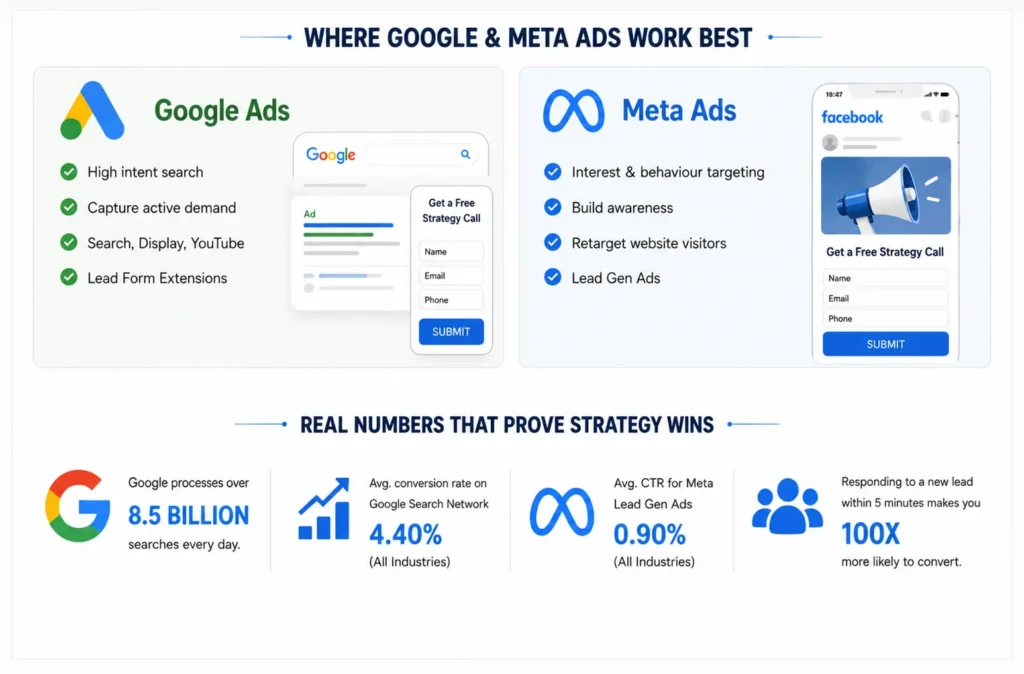
Google processes over 8.5 billion searches every single day. Even capturing a tiny fraction of those people searching specifically for your service represents an enormous revenue opportunity. The businesses that capture that opportunity consistently are not the ones with the biggest ad budgets. They are the ones with the most structured and intentional strategies.
According to WordStream, the average conversion rate across all industries on Google’s Search Network is around 4.40 percent. But the top performing accounts regularly achieve conversion rates of 10 percent or higher. The gap between average and excellent is almost always explained by landing page quality, audience targeting precision, and ad relevance, not by how much money was spent.
On the Meta side, the average click-through rate for lead generation ads sits around 0.90 percent across all industries. However, advertisers who consistently test their creative and segment their audiences properly regularly achieve click-through rates between 2 and 4 percent. That difference compounds quickly when you are spending thousands of dollars each month.
The Mistakes That Are Quietly Killing Your Lead Generation Results
Sending all paid traffic to your homepage is one of the most expensive mistakes a business can make. Your homepage is designed for general visitors who want to explore. A landing page is designed for one specific action. Always send paid ad traffic to a dedicated page that matches exactly what your ad promised.
Skipping the creative testing phase wastes budget that could be generating leads. You should always run at least two or three variations of your ad copy and visuals against each other simultaneously. What you assume will perform well and what actually performs well are often completely different. Let real data make that decision for you.
Not following up with leads fast enough is another silent conversion killer. Studies consistently show that responding to a new lead within five minutes makes you 100 times more likely to convert them compared to waiting even 30 minutes. Set up automated email and text message follow-up sequences that activate the moment someone submits a form.
Ignoring negative keywords on Google Ads allows your budget to get eaten by irrelevant searches that will never convert. Reviewing your search term reports weekly and adding negative keywords keeps your traffic clean and your cost per lead low over time.
Frequently Asked Questions
Q: What is the difference between Google Ads and Meta Ads?
A: Google Ads targets people searching for solutions, while Meta Ads targets users based on interests and behaviour. Google captures demand, Meta creates demand.
Q: How much budget is needed for good results?
A: Most businesses should start with at least $1,000–$2,000 monthly for proper campaign data and optimisation.
Q: What is a good cost per lead?
A: It depends on the industry. Many businesses see good results between $30–$100 per lead, while competitive industries may pay more.
Q: How long before paid ads generate consistent leads?
A: Most campaigns need 30–90 days to build a steady and predictable lead flow.
Q: Is retargeting important for paid ads?
A: Yes. Retargeting helps reconnect with visitors who did not convert the first time, often at a lower cost.
Conclusion: Build the Strategy Before You Build the Campaign
Successful lead generation with Google and Meta Ads is a system built around your customer’s decision journey. It starts with reaching the right people when they first become aware of a problem, moves into building enough trust that they consider your solution seriously, and finishes with converting that consideration into a real inquiry or sale.
The businesses seeing the strongest results in the US market are not always the ones with the largest budgets. They are the ones with clear targeting, compelling ad creative, dedicated landing pages optimized for conversion, and a fast and consistent follow-up process on every single lead.
If you are a business owner or marketing team in the United States looking to build a smarter paid ads lead generation system, Webtrack Technologies is a trusted Digital Marketing & Development Agency in the USA, partnering with clients across New York, California, Texas, Florida, and Illinois to develop data driven strategies that deliver real, measurable results.
For more information, visit here to start a conversation about what the right strategy looks like for your business.