
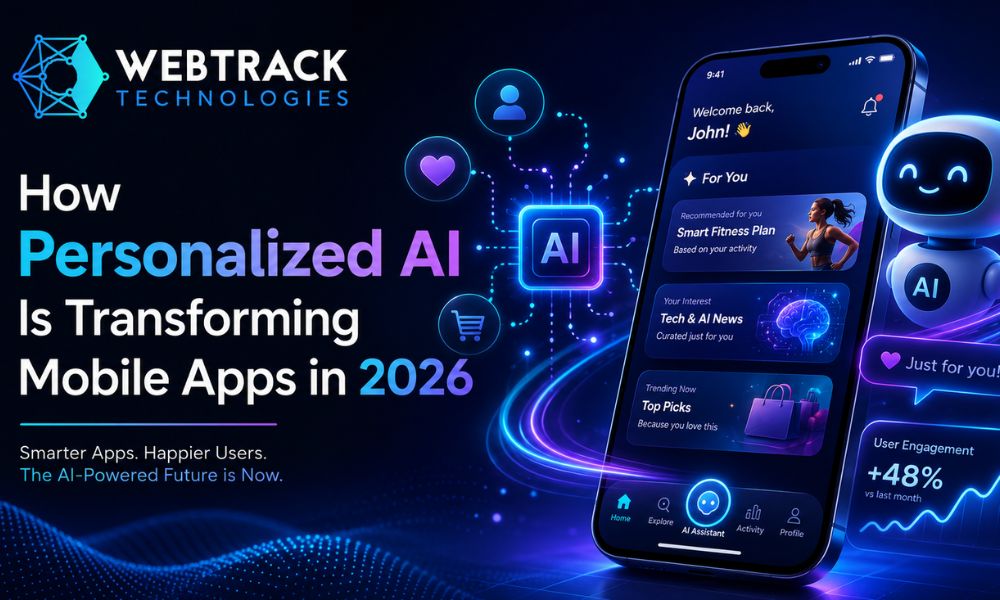
We live in a time when your phone feels like it knows you better than anyone. It suggests a playlist before you even think about music. It reminds you to drink water at the exact time. It predicts what you want to order for lunch based on your mood, location, and past choices. This is not magic. This is personalized AI at work inside mobile apps.
In 2026, this technology is no longer just an extra feature. It has become an important part of how mobile apps are created, designed, and launched around the world, including in the USA.
If you run a business, build apps, or simply use your smartphone every day, understanding how personalized AI is changing mobile app development matters more than ever. This blog breaks it all down in plain, simple language so anyone can follow along.
What Is Personalized AI and Why Does It Matter for Mobile Apps
Personalized AI refers to artificial intelligence that learns from user behaviour and delivers a unique experience to each individual. Instead of one-size-fits-all content or features, the app adapts to you specifically.
Think about apps like Netflix, Spotify, or even your banking app. They all use some form of AI-driven personalization. The app studies what you do, when you do it, and why, and then it adjusts itself to make your experience smoother and more relevant.
In 2026, this kind of smart behaviour is no longer reserved for tech giants. Even small businesses are building apps with AI personalisation baked right in from day one.
According to a report, companies that get personalization right generate 40% more revenue than those that do not. That is a number no business owner can ignore.
How Personalized AI Is Reshaping Mobile App Development in 2026
The way apps are built has shifted dramatically over the past few years. Developers are no longer just writing code and testing features. They are now training AI models, building adaptive user interfaces, and designing systems that learn over time.
Here are the biggest trends driving this change right now.
AI-Driven User Interfaces That Change in Real Time
In the past, every user who opened an app saw the same home screen. In 2026, that is not the case anymore. Apps now use machine learning to rearrange content, change button placement, adjust colours, and even modify language tone based on individual user habits.
For example, a fitness app might show a beginner user simple workout cards while showing an advanced user detailed training analytics. Both users open the same app but see completely different experiences. This is what smart personalisation looks like in practice.
If you are working with a Mobile App Development Company in USA, the best ones are already building this kind of adaptive interface logic into their development process from the very start.
Predictive Personalization Using Behavioural Data
Modern apps collect data points at every step. What you tap, how long you stay on a screen, what you skip, when you exit, all of this feeds into AI models that predict what you will want next.
This is called predictive personalization, and it is one of the most powerful tools in app development today. It helps businesses reduce churn, increase session length, and boost in-app purchases or conversions without being pushy or intrusive.
A great real-world example is Amazon’s mobile app. Before you even search for something, it has already populated your homepage with items you are likely to buy based on your previous shopping sessions. That level of prediction did not happen overnight. It took years of AI training and smart data architecture.
Natural Language Processing Inside Apps
NLP, or natural language processing, is the technology that allows apps to understand and respond to human language. In 2026, NLP is embedded inside customer support bots, voice assistants, in-app search tools, and feedback systems.
When a user types a question in imperfect English or speaks in a regional accent, modern AI can still understand what they mean and give a helpful answer. This makes apps accessible to a far wider audience, including users in regional areas of the USA who may not always use formal language.
For businesses wanting to explore custom app solutions, NLP integration is one of the most requested features in 2026.
Real-Time Recommendations and Dynamic Content Delivery
Apps in 2026 serve content in real time based on contextual signals. This includes your location, time of day, device type, recent activity, and even weather conditions.
A travel app might show beach resorts when it detects you are near a coastline on a sunny Friday afternoon. A food delivery app might push healthy meal options on Monday mornings and comfort food on rainy evenings. These are not random. They are calculated decisions made by AI in milliseconds.
This kind of dynamic content delivery is a major reason why users stay in apps longer and return more frequently.
Key Areas Where Personalized AI Is Making the Biggest Impact
| Area | AI Application | Business Benefit |
| User Onboarding | Adaptive flows based on user goals | Higher completion rates |
| In-App Search | NLP-powered intelligent search | Faster product discovery |
| Push Notifications | AI-timed, personalized alerts | Better open rates |
| Customer Support | Smart chatbots with memory | Lower support costs |
| Content Feed | Behaviour-based ranking | Longer session times |
| E-commerce | Predictive product suggestions | Higher cart values |
Why Businesses in the USA Are Investing in AI-Powered Mobile Apps
The competitive pressure in the American market is intense. Whether you are a startup in Austin or an established brand in New York, your app needs to stand out. Generic apps no longer cut it.
Businesses across industries, from healthcare and finance to retail and education, are now demanding intelligent apps that serve users individually. This has pushed the demand for skilled Custom Mobile Application Development Company in USA services to new heights.
The return on investment is measurable. Apps that use personalized AI see higher retention, better engagement scores, and stronger user lifetime value compared to apps that deliver the same experience to everyone.
A 2025 Gartner study found that 75% of enterprise mobile apps now use some form of AI personalisation, compared to just 30% in 2021. That growth shows no signs of slowing down.
The Role of Machine Learning, Deep Learning, and AI Algorithms
For those curious about how this all works under the hood, here is a simple breakdown.
Machine learning allows an app to find patterns in data without being explicitly programmed to do so. Over time, it gets smarter the more data it processes.
Deep learning is a more advanced form of machine learning that uses neural network architectures to learn complex patterns, such as recognising a user’s emotional state from their typing speed or identifying a product from a blurry photo.
AI algorithms connect these two and apply them in real time to deliver personalized outcomes for each user.
Developers working on cutting-edge apps need a solid understanding of these tools. If you want to explore the benefits of mobile app development that include AI capabilities, these technical foundations are what makes everything possible.
Challenges Developers Face When Building Personalized AI Apps
Building these apps is not without its hurdles. Here are some real challenges the industry is working through right now.
Data Privacy and User Consent
Personalized AI needs data to work. But collecting that data responsibly is a major concern, especially in the USA, where regulations like CCPA and various state-level privacy laws are getting stricter.
Developers must build apps that are transparent about data use, give users clear control over their information, and comply with all relevant rules. Failure to do this can result in fines, app store removal, or loss of user trust.
High Development Costs Without the Right Partner
AI-powered features add complexity to the development process. If you are not working with an experienced team, costs can spiral quickly. Understanding the mobile app development cost and key factors before you start is essential so you can plan your budget wisely.
Bias in AI Models
AI learns from data. If that data has bias baked in, the AI will reflect that bias in its recommendations. For example, a hiring app that learned from historical data might inadvertently favour certain demographics over others. Responsible AI development requires diverse datasets and ongoing monitoring.
Battery and Performance Optimisation
Running AI models on a mobile device consumes processing power and battery life. Developers have to balance the depth of AI personalisation with performance to make sure the app remains fast and light to use.
What Good Personalized AI Looks Like in Practice
Let us paint a real picture. Imagine a health and wellness app in the USA.
When a new user signs up, the app asks a few simple questions about their goals, lifestyle, and preferences. This takes two minutes. From that point on, the app uses AI to build a personalized dashboard. It learns that this user prefers morning workouts, struggles with consistency on Wednesdays, and likes motivational messages rather than data-heavy reports.
Over the next few weeks, the app starts sending a Wednesday morning nudge, adjusts the workout difficulty based on completed sessions, and swaps out data charts for visual progress cards. The user never had to change a setting manually. The app figured it all out.
This is the kind of experience that makes users loyal. And this is what separates a smart app from a basic one in 2026.
What to Look for in a Mobile App Development Partner
If you are planning to build or upgrade a mobile app with AI personalisation features, choosing the right development partner is the most important decision you will make.
Look for a team that has real experience with AI and machine learning integrations, not just teams that list it as a capability. Ask to see examples. Ask how they handle user data. Ask how they test and improve AI models after launch.
The best Mobile App Development Services in the USA will have a clear process for discovering your business needs, designing adaptive user experiences, and measuring the performance of AI features after the app goes live.
You also want a team that understands your industry, your users, and the specific compliance requirements you need to follow, especially if you are in healthcare, finance, or education.
FAQ Section
Q: What is personalized AI in mobile apps?
A: Personalized AI in mobile apps refers to artificial intelligence that studies individual user behaviour and adapts the app experience to suit each person. It uses machine learning, NLP, and behavioural data to deliver content, recommendations, and features that feel tailor-made.
Q: How does AI personalisation improve user engagement?
A: It makes the app feel relevant and useful. When users see content and features that match their needs and habits, they spend more time in the app, return more often, and are more likely to complete purchases or take action.
Q: Is personalized AI expensive to build?
A: The cost depends on the complexity of the features and the experience of the development team. Working with a skilled partner who understands AI integration from the start helps avoid expensive mistakes and keeps development efficient.
Q: Is user data safe in AI-powered apps?
A: It depends on how the app is built. Responsible developers build privacy controls, data encryption, and clear consent flows into the app. Always look for apps that are transparent about how they use your data.
Q: What industries benefit the most from AI personalisation in mobile apps?
A: E-commerce, healthcare, fitness, finance, education, and entertainment are seeing the biggest benefits. Any industry where user experience and engagement directly impact revenue can gain from AI-driven personalisation.
Conclusion
Personalized AI is no longer something for the future. In 2026, it will already be helping people through the mobile apps they use every day. From giving content recommendations and smart search results to creating a more personalized user experience, AI is making apps smarter and more useful.
For businesses in the USA, adding AI features to mobile apps is becoming important to meet customer expectations and stay ahead of competitors. Users now expect apps to understand their needs and provide a smooth, customised experience.
If you want to build an intelligent, scalable, and user-friendly mobile app, Webtrack Technologies can help. With experience in AI-powered app development, the team can support you through every stage, from planning and development to launch and ongoing growth.