

The digital landscape has completely transformed, and with it, the way cybercriminals strike. If you run a business, you might think your internal defenses are solid because you have strong firewalls and updated antivirus software. However, today’s attackers rarely try to kick down your front door. Instead, they exploit the third-party software, cloud applications, hardware vendors, and digital platforms that you use every day.
By compromising a single trusted supplier, attackers can slip right past your security perimeter and access your sensitive customer details, operational files, and financial records. Data from the Verizon Data Breach Investigations Report reveals that third-party involvement in data breaches doubled to 30% recently, marking the sharpest single-year increase in cybersecurity history. Furthermore, research from IBM places the average cost of a supply chain compromise at $4.91 million, requiring an average of 267 days to detect and fully contain.
For modern businesses, managing third-party risk is no longer optional—it is a critical requirement for survival. Let us break down exactly how these vulnerabilities work across your entire ecosystem, explore the top ten real-world supply chain security breaches you must know about, and discuss how you can protect your operations with comprehensive cybersecurity services.
The Three Vectors of Supply Chain Risk
To protect your enterprise, you first need to understand the main paths cybercriminals use to compromise external vendors. These issues generally fall into three core categories:
1. Software Supply Chain Vulnerabilities
This happens when hackers inject malicious code into legitimate applications, open-source libraries, or automated update channels. Because your operating systems trust these packages, they install the poisoned updates without throwing an alert. A major risk area includes unmanaged code packages downloaded from open public registries like npm or PyPI, which can quickly spread malware downstream into thousands of business systems.The Vimeo and Anodot Analytics Compromise

2. Hardware Supply Chain Vulnerabilities
Physical hardware components can also be tampered with long before they arrive at your corporate office. Rogue firmware modifications, backdoored microchips, or malicious bootloaders can be embedded into servers, network switches, or communication devices during manufacturing or shipping. Because these threats sit far below the operating system layer, traditional endpoint protection tools usually cannot see them.
3. Network and Service Provider Vulnerabilities
Your business likely shares network connections, cloud API keys, or administrative access with external partners like Managed Service Providers (MSPs), data analytics platforms, or legal firms. If an attacker gains access to a vendor’s network, they can easily pivot straight through those trusted digital bridges into your internal environment, stealing active data without needing to crack your main passwords.
Top 10 Supply Chain Security Breaches
Here are the ten most significant, real-world supply chain attacks that demonstrate exactly how modern third-party vulnerabilities can impact global business operations.
1. The Shai-Hulud Worm and Trust Wallet Breach
A highly sophisticated open-source supply chain campaign struck the decentralized finance world via a malicious npm registry package. Attackers hijacked developer credentials to push a poisoned version of an official browser extension. The malicious code operated like a registry-native worm, automatically draining $8.5 million from more than 2,500 active user wallets the moment they unlocked their applications. This incident forced a massive industry push toward stricter code provenance tracking.
2. The Cisco Unified Communications Zero-Day (CVE-2026-20045)
A critical zero-day flaw was discovered in the web-based management interface of Cisco’s widely used Unified Communications products, including IM & Presence and Webex Calling Dedicated Instances. Remote attackers used specially crafted HTTP requests to bypass security checks, execute deep system commands, and claim root privileges. Because countless enterprise vendors and communication service providers rely heavily on this infrastructure, the exploit gave attackers a direct path into corporate communication networks globally.
3. The TanStack “Mini Shai-Hulud” Campaign
In a major software supply chain incident, threat actors associated with the group TeamPCP successfully compromised popular TanStack code packages. These packages are core building blocks utilized heavily across modern web applications. The attackers embedded stealth code designed to harvest GitHub credentials, cloud access tokens, and automated CI/CD keys from developer systems. This breach quickly rippled downstream, directly impacting development environments at major organizations like OpenAI and Grafana.
4. The Jaguar Land Rover Supply Chain Ripple
While the initial network infiltration occurred late prior, the immense economic aftershocks of this massive multi-tiered supplier disruption peaked with stunning clarity. A severe operational halt across key sub-component vendors triggered an estimated £1.5 billion cash outflow impact. The disruption was so severe that parent company Tata Motors reported an immense consolidated net loss of over ₹3,486 crore in its financial filings, completely redefining how modern enterprises calculate material risk for vendor dependencies.
5. The GitHub “Megalodon” Automated Commit Attack
This widespread automated repository campaign corrupted more than 5,500 development projects simultaneously. Cybercriminals used stolen developer secrets to make malicious code updates disguised as legitimate, automated system contributions. Once a development team accepted these poisoned commits into their pipeline, the hidden malware immediately scanned and stole cloud administrative credentials, Kubernetes configurations, and automated deployment tokens before attempting to compromise connected client applications.
6. The Vimeo and Anodot Analytics Compromise
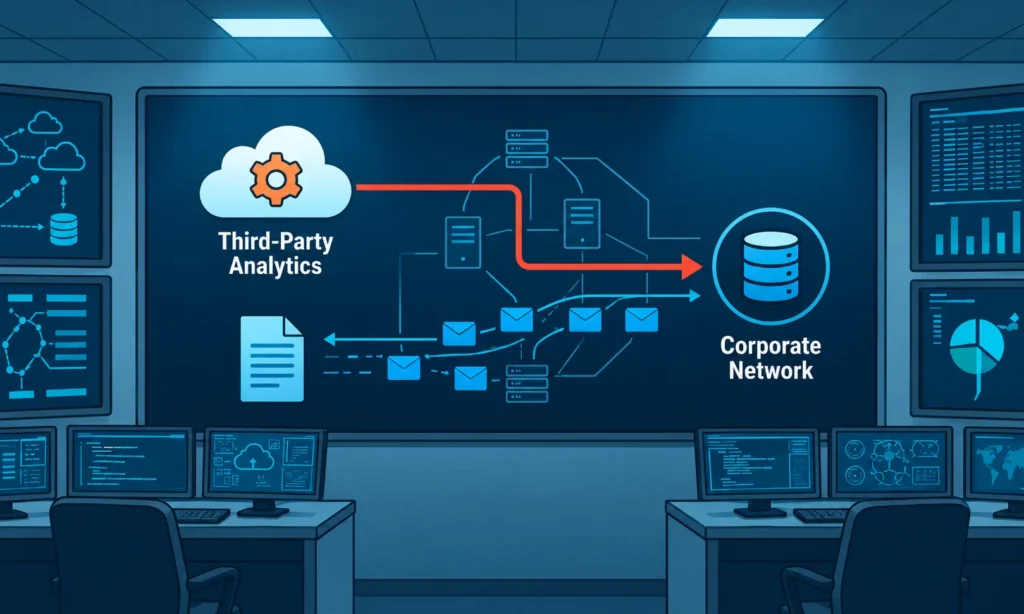
Hackers successfully gained unauthorized access to sensitive internal data stores by targeting Anodot, a popular third-party data analytics provider utilized by major digital platforms. By stealing and abusing active authentication tokens held within the vendor’s analytics relationship, the cybercriminals bypassed standard firewalls. This third-party pivot ultimately exposed the private system data and account configurations of approximately 119,000 Vimeo users.
7. The Trellix and Security Vendor Pipeline Breach
Cybersecurity vendor Trellix disclosed a major source code repository compromise linked to coordinated supply chain infiltration activity by TeamPCP. The sophisticated campaign specifically targeted corporate GitHub accounts to siphon proprietary tools and code bases. The attack spread far beyond a single firm, systematically hitting widely integrated open-source vulnerability scanners and automated code review tools like Trivy and Checkmarx KICS, showing that even security vendors are prime targets.
8. The Nx Console VS Code Extension Infiltration
Cybercriminals successfully injected a malicious Trojan horse into the official Nx Console extension, a highly popular developer tool used extensively inside Visual Studio Code environments. Instead of targeting end customers, the attackers focused upstream on software engineers who naturally hold high-level administrative access to corporate code repositories and cloud infrastructure. The compromised extension silently harvested internal development keys, giving the hackers a quiet path into corporate build pipelines.
9. The Lite LLM Model Pipeline Compromise
As enterprise reliance on artificial intelligence tools soared, attackers focused directly on open-source AI infrastructure. Cybercriminals successfully compromised specific versions of LiteLLM, a widely integrated proxy framework used by corporations to manage multiple Large Language Models. The poisoned versions allowed attackers to intercept internal corporate data streams, redirect API keys, and perform model poisoning attacks, proving that AI data pipelines are now a primary target for supply chain actors.
10. The SolarWinds Web Help Desk Vulnerability (CVE-2025-40551)
Building on the history of upstream attacks, a critical remote code execution flaw was uncovered in the SolarWinds Web Help Desk software. Because this tool handles IT help tickets, user account credentials, and system privileges across thousands of mid-market corporate networks, the vulnerability allowed remote threat actors to slip directly into internal corporate networks completely unauthenticated, turning basic support software into an open back door.
How to Check If Your Business Is Compromised
If you suspect that a vendor breach has exposed your internal infrastructure, you need to act immediately. Use these practical troubleshooting steps to check your corporate environment for signs of a third-party compromise:

- Audit Active Identity Logs: Look closely at your access management dashboard. Scan for unusual login locations, odd hours, or unexpected multi-factor authentication (MFA) device registrations coming from third-party vendor accounts.
- Inspect API and OAuth Connections: Review all active integrations, third-party analytics plugins, and marketing extensions. Immediately revoke access for any tools or plugins that your team no longer actively uses or cannot identify.
- Run Code Integrity Checks: If your company builds software, run deep dependency scans on your development pipelines. Check your Software Bill of Materials (SBOM) to verify that your open-source libraries match verified public hashes.
- Monitor Network Outbound Traffic: Look for unusual, large data transfers leaving your internal databases and heading toward unverified public cloud IP addresses. This is often a primary indicator of active data theft.
When to Seek Professional Corporate Cyber Repair
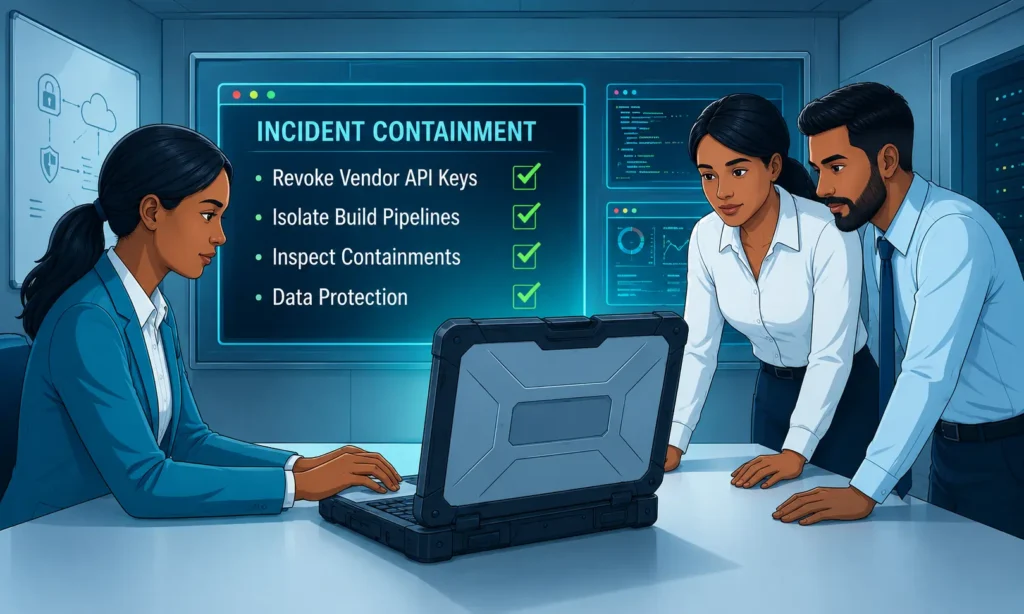
While basic access revocation can contain small issues, complex supply chain compromises require specialized intervention. You must engage professional enterprise incident response teams immediately if you experience any of the following scenarios:
+————————————————————————–+
| CRITICAL ALERTS FOR PROFESSIONAL INTERVENTION |
+————————————————————————–+
| 1. ACTIVE RANSOMWARE OR LARGE DATA EXFILTRATION DETECTED |
| Attackers are actively moving laterally or demanding payment. |
+————————————————————————–+
| 2. COMPROMISED CORE CI/CD PIPELINES OR CODE REPOSITORIES |
| Proprietary software products or developer environments are tainted. |
+————————————————————————–+
| 3. RECURRING INTRUSIONS VIA THIRD-PARTY VENDOR CREDENTIALS |
| Malware reappears after manual deletion or password resets. |
+————————————————————————–+
| 4. MANDATORY REGULATORY COMPLIANCE REPORTING IS TRIGGERED |
| Breach involves protected customer records, PII, or health data. |
+————————————————————————–+
When custom code environments are tampered with, or when bad actors embed deep persistence mechanisms within your cloud architecture, standard antivirus tools are not enough. Dedicated enterprise cybersecurity firms provide the advanced forensic analysis, deep root-cause identification, and secure architecture rebuilding necessary to thoroughly clean your systems and restore full operational trust. To understand why professional oversight is the gold standard for resilience, check out how cybersecurity services protect us businesses.
Frequently Asked Questions
Q: What exactly is a supply chain cyber attack?
A: A supply chain cyber attack occurs when hackers breach a trusted vendor, supplier, or software provider to gain indirect access to a target organisation’s systems and data.
Q: Why are third-party security breaches increasing?
A: Attackers often target suppliers and third-party tools because they can provide easier access to multiple organisations through a single compromised partner.
Q: What is a Software Bill of Materials (SBOM)?
A: An SBOM is a detailed inventory of all software components and dependencies used in an application, helping teams identify and manage security risks faster.
Q: How does Zero Trust architecture reduce supply chain risk?
A: Zero Trust limits access and continuously verifies users and systems, helping contain threats even if a vendor or third-party service is compromised.
Secure Your Business Operations Today
Protecting your enterprise from evolving digital threats requires constant vigilance, continuous attack surface monitoring, and proactive third-party risk governance. If your organization needs expert help auditing vendor integrations, implementing secure Zero Trust controls, or building resilient digital defenses, the experienced consulting team at Webtrack Technologies is ready to assist. Based in the USA, they help growing businesses identify hidden vulnerabilities, secure critical software delivery pipelines, and build comprehensive incident response programs to ensure long-term operational resilience.