
The Pipeline Problem Most B2B Companies Face
Most B2B companies share the same quiet frustration. The product is solid. The team is skilled. But the sales pipeline looks like a rollercoaster, busy one month, completely dry the next. Revenue becomes unpredictable. Growth stalls. And leadership starts asking uncomfortable questions at Monday morning meetings.
Here is the truth: inconsistent pipelines are not a product problem or even a talent problem. They are almost always a prospecting problem. When your team relies only on referrals, inbound leads, or occasional networking events, you are essentially waiting for business to come to you. In today’s hyper-competitive B2B environment, waiting is a strategy that rarely wins.
This is exactly where outbound sales services step in. Not as a shortcut, but as a proven, structured system for building a qualified pipeline at scale. Combined with effective B2B lead generation services, outbound strategies help businesses connect with decision-makers faster and create more predictable revenue opportunities. According to a 2023 report by Demand Gen Report, 68% of B2B buyers prefer to be contacted by vendors through outbound methods before making a purchasing decision. That number alone tells you outbound is far from dead. In fact, it is evolving faster than most sales leaders realize, and when executed correctly, it becomes one of the most reliable growth levers available to any B2B organization.
Whether you are a SaaS startup trying to land your first 100 enterprise clients or an established professional services firm looking to break into new verticals, understanding how outbound sales services work and why they accelerate growth can completely change how you think about revenue generation.
Why Inbound Alone Cannot Build a Scalable Pipeline
Many companies make the mistake of betting everything on inbound marketing. Content production, SEO campaigns, paid advertising, and webinars are all valuable channels. But they come with a significant limitation: they are passive. You create the content, publish it, and then you wait. You wait for Google to rank it. You wait for a prospect to stumble across it. You wait for someone to fill out a contact form.
This passive approach creates the very inconsistency that keeps sales leaders awake at night. Inbound traffic fluctuates with algorithm changes, content trends, and seasonal buying cycles. When the traffic drops, the pipeline drops with it. And by the time leadership notices the pipeline is thin, it is already too late to course-correct for that quarter.
Outbound sales services solve this problem at the root level. Instead of waiting for prospects to find you, you go directly to the decision makers. This is called proactive demand generation, and it is the single most effective way to compress your pipeline-building timeline from months to weeks.
A real-world example worth noting: Salesforce built a significant portion of its early enterprise growth not through inbound content alone, but through a highly disciplined outbound SDR model. Their outbound teams targeted specific industries, used structured messaging frameworks, and ran consistent multi-touch cadences until meetings were booked. That model became the blueprint that thousands of B2B companies have since adopted and refined.
What Outbound Sales Services Actually Include
There is a version of outbound that gives the entire approach a bad reputation. It is the spray and pray model, blasting generic cold emails to massive unverified lists with no personalization and no strategy. Most recipients delete these instantly, and the sender wonders why outbound does not work.
Then there is the engineered version. Data-driven, ICP specific, cadence-based, and continuously optimized. This is what modern outbound sales services actually deliver. The difference between these two approaches is not just in the results. It is in the entire operating philosophy.
A properly structured outbound sales service includes the following components working together as one integrated system.
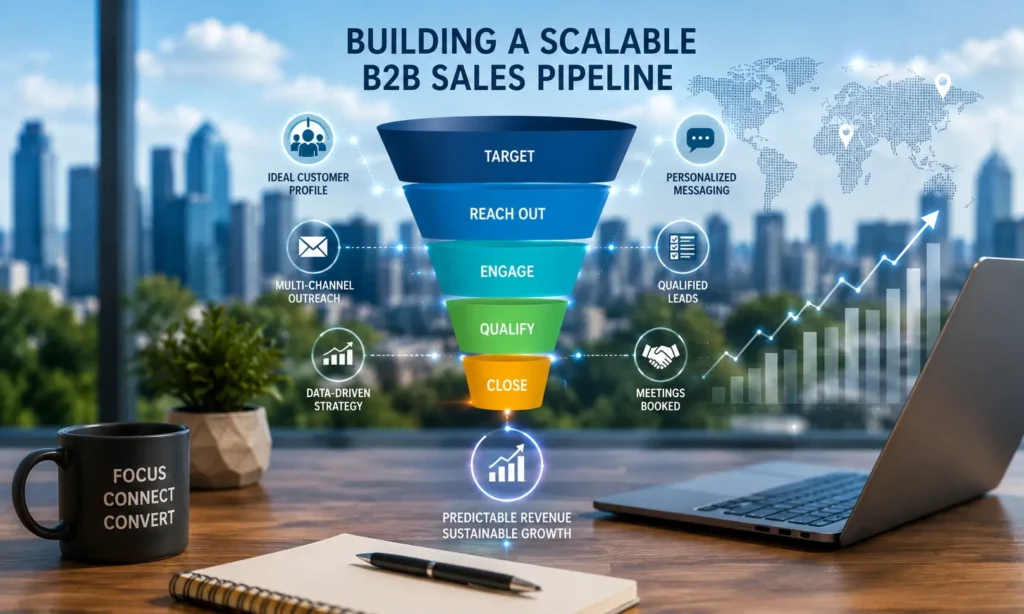
The first is the ideal customer profile definition. Before a single email is sent or a single call is made, a good outbound partner works with you to define exactly who you are selling to. This includes firmographic data such as company size, industry, annual revenue, geography, and employee count. It also includes technographic signals, meaning what tools and software your target companies are already using, and behavioral triggers such as recent funding rounds, new executive hires, or expansion announcements. When you know precisely who you are targeting, every outreach effort becomes significantly more efficient.
The second is verified contact data and database management. Outbound only works when it reaches real people at real companies. A professional outbound sales service maintains clean, regularly verified contact lists using tools like ZoomInfo, Apollo, Lusha, or Clearbit. Stale or inaccurate data wastes time and damages the sender’s reputation.
The third is multi-channel outreach sequencing. The most effective outbound programs do not rely on a single channel. They combine cold email, LinkedIn connection and messaging, phone outreach, and in some cases personalized video messages into a coordinated sequence. This multi-touch approach dramatically increases the likelihood of getting a response because different prospects engage on different platforms at different times.
The fourth is buyer intent data integration. Advanced outbound services layer in intent signals from platforms like Bombora or G2. These signals reveal which companies are actively researching solutions like yours right now, allowing your outreach team to prioritize the warmest accounts and reach them before your competitors do.
The fifth is structured sales cadences with A/B testing. Research from RAIN Group found that it takes an average of eight touchpoints to secure an initial meeting with a new B2B prospect. Most salespeople stop after two or three attempts. Outbound services build cadences that account for this reality, automating the timing and personalizing the messaging while continuously testing subject lines, call scripts, and value propositions to improve performance over time.
The sixth is detailed performance reporting. A reliable outbound partner tracks everything: open rates, reply rates, call connection rates, meeting booked rates, pipeline contribution, and cost per opportunity. These metrics allow you to see exactly where the process is working and where it needs adjustment, turning your sales development function into a continuously improving system rather than a guessing game.
How Outbound Sales Services Make Your Pipeline Scalable and Predictable
The word scalable gets used loosely in business conversations. But in the context of B2B pipeline building, it has a very specific meaning. A scalable pipeline grows at a predictable rate in direct proportion to the inputs you put in: the number of qualified prospects contacted, the number of cadence sequences running, and the number of meetings booked each week.
Random prospecting is not scalable. Referrals are not scalable. Networking events are not scalable. Outbound sales services, when built on a systematic, data-driven foundation, absolutely are.
Here is why this matters for your business. When you have a repeatable outbound system running, you can predict with reasonable accuracy how many meetings your team will book next month, how many of those will convert to qualified opportunities, and how many opportunities will close into revenue. That predictability transforms how your leadership team makes decisions. Hiring plans, expansion budgets, and investor conversations all of these become easier when your pipeline is no longer a mystery.
A Gartner study found that companies combining outbound sales development with account-based marketing strategies see 38% higher win rates on enterprise deals compared to companies relying solely on inbound traffic. That is not a marginal improvement. That is a structural competitive advantage.
The Cost Reality of Building a Pipeline the Right Way
Here is something that surprises many business leaders when they first look at the numbers. Building an internal SDR team from scratch in the United States costs an average of $180,000 to $220,000 per year when you factor in base salary, benefits, payroll taxes, sales engagement software, data subscriptions, training costs, and the three to six-month ramp time before a new hire becomes productive.
And even after all of that investment, internal SDR teams face high turnover rates. The average tenure of an SDR in the United States is just 14 months, according to data from The Bridge Group. Which means you are constantly recruiting, onboarding, and retraining, all while your pipeline generation slows down.
Outsourced outbound sales services flip this model entirely. You get an experienced team with existing infrastructure, proven messaging playbooks, pre-built technology stacks, and immediate ramp time. Most outsourced outbound partners become fully operational within two to four weeks, meaning your pipeline starts filling faster without the overhead, turnover risk, or management burden of building a team internally.
This is why B2B companies across cities like Austin, Chicago, New York, Dallas, Atlanta, and San Francisco are increasingly choosing outsourced outbound partners to build a pipeline without sacrificing speed or quality.
Turning Outbound Conversations Into Closed Revenue
Outbound sales services do not just generate awareness. When structured correctly, they support the entire buyer journey from first contact to closed deal.
At the early stage, the focus is on proactive demand generation, identifying the right accounts, reaching decision makers with relevant messaging, and starting conversations that would not have happened organically. This fills the top of your pipeline with qualified prospects who match your ICP rather than random inquiries that waste your closing team’s time.
As prospects engage and show interest, outbound teams shift into discovery and qualification mode. Structured discovery calls help identify budget, authority, need, and timeline. Personalized case studies and ROI focused conversations help prospects understand the tangible business value of moving forward. Multi-touch follow-up sequences keep warm prospects engaged without being aggressive or off-putting.
At the deal acceleration stage, outbound support helps break through internal blockers, coordinate multi-stakeholder conversations, and create urgency that gets proposals signed rather than endlessly delayed. Trigger based follow ups, for example, when a prospect revisits your pricing page or reopens your proposal, allow your team to reach out at exactly the right moment with exactly the right message.
This connected, full journey approach is what separates modern outbound sales services from the outdated cold calling playbooks of the past. It is not just about generating leads. It is about building relationships at scale and moving them through a system designed to convert.
Frequently Asked Questions
Q: What is the difference between inbound and outbound sales?
A: Inbound relies on attracting prospects through content and advertising.
Q: How quickly do outbound sales services produce results?
A: Most programs generate qualified meetings within four to eight weeks, with full pipeline impact visible within ninety days depending on deal cycle length.
Q: Is cold calling still effective in B2B?
A: Yes, when combined with proper research and personalization.
Q: What industries benefit most?
A: SaaS, IT services, professional services, logistics, healthcare technology, and financial services all see strong returns from structured outbound programs.
Building the Pipeline Your Business Actually Deserves
The companies that dominate B2B markets over the next decade will not simply have the best products. They will have the most disciplined, data-driven, and consistently executed outbound sales motion. Inconsistent pipelines are not an inevitable reality. They are a systems problem, and systems problems have systems solutions.
If your pipeline has felt thin, unpredictable, or dangerously dependent on a handful of referral sources, the answer is not to hire more closers and hope for the best. The answer is to build a smarter prospecting engine upstream that feeds your closers with a consistent, qualified flow of opportunities every single month.
The pipeline you want is not a matter of luck or timing. It is a matter of building the right outbound system, running it consistently, and continuously improving it based on real performance data.
Webtrack Technologies partners with companies across the United States to design and execute outbound sales programs that deliver measurable pipeline growth built on strategy, verified data, and personalized outreach that actually earns responses from the decision-makers who matter most to your business. With the right B2B and B2C lead generation strategies, businesses can target the right audience, improve engagement, and generate high-quality leads that support long-term growth.