
The Search Game Has Changed – And Most Businesses Haven’t Caught Up
Imagine putting months of effort into a blog post, earning a top-three Google ranking, and still getting almost no traffic from it. Sounds frustrating, right? For millions of website owners across the United States, this is the new reality.
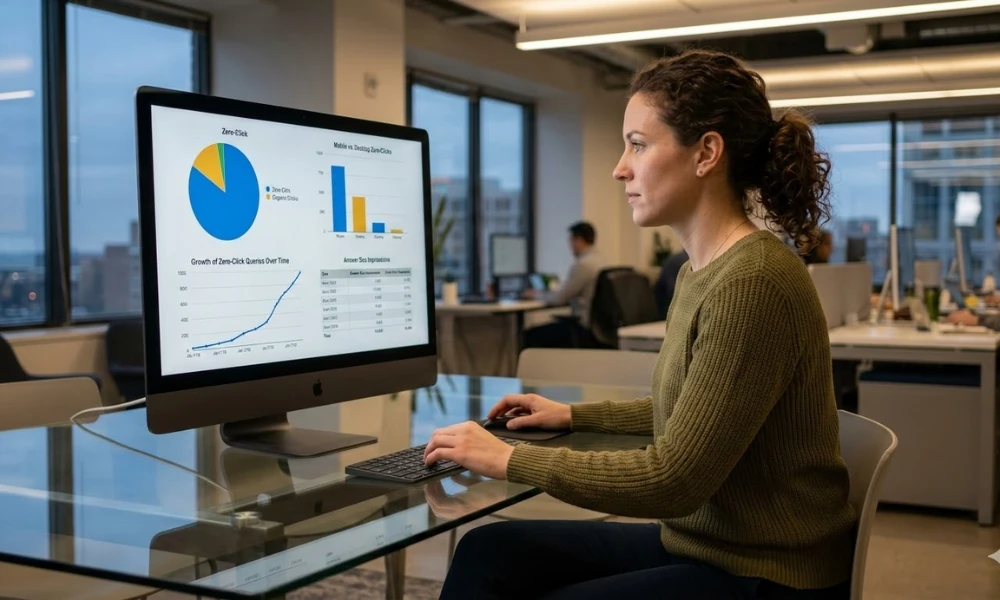
Zero-click searches search queries where users get their answer directly on the Google results page without clicking any link now account for a staggering portion of all online searches. According to data from SparkToro and Semrush, more than 50% of Google searches in the U.S. end without a single click to any website. On mobile devices, that number climbs even higher.
If you’ve noticed a steady decline in organic traffic despite maintaining strong keyword rankings, zero-click search behavior could be the invisible force behind it. Understanding what’s driving this shift and how to strategically respond is no longer optional for businesses that depend on digital visibility. It’s survival.
This guide breaks down the data, the causes, the risks, and most importantly, what smart brands are doing right now to stay relevant in a zero-click world.
What Exactly Is a Zero-Click Search?
A zero-click search occurs when a search engine, primarily Google, satisfies a user’s query directly within the search engine results page (SERP) itself, eliminating the need to visit any external website.
This happens through several SERP features, including:
- Featured Snippets (answer boxes that pull text from a webpage)
- Knowledge Panels (information about brands, people, and organizations)
- People Also Ask (PAA) boxes (expandable Q&A sections)
- Local Pack results (Google Maps-driven local business listings)
- Rich Results and Structured Data cards (recipes, events, FAQs, product info)
- AI Overviews (Google’s generative AI summaries at the top of results)
- Calculator, converter, and dictionary tools built directly into Google
Each of these features delivers instant answers. The user is satisfied. The click never happens.
The Big Picture – Why Zero-Click Searches Are Matter
Google’s Evolving Search Intent Strategy
Google’s core mission has always been to “organize the world’s information and make it universally accessible and useful.” Zero-click features are the logical conclusion of that mission. When Google can answer a question faster and more accurately directly on the results page, it does.
Search intent and the reason behind a query plays a massive role here. Informational queries like “what is the capital of Texas,” “how many ounces in a pound,” or “symptoms of high blood pressure” are almost always resolved without a click. Navigational and transactional queries still drive clicks, but informational intent now dominates search volume across the web.
The Rise of AI Overviews and Generative Search
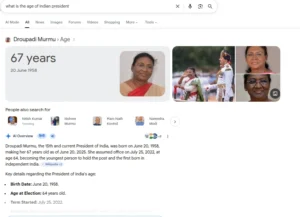
In 2024, Google rolled out AI Overviews (formerly Search Generative Experience) across the U.S. These AI-generated summaries appear at the very top of search results and synthesize information from multiple sources into a single, concise answer.
Early studies show that AI Overviews reduce organic click-through rates (CTR) by anywhere from 20% to 60% depending on query type and industry. For content marketers and SEO professionals, this is a seismic shift. It’s not just about ranking anymore it’s about being the authoritative source that AI models pull from when generating those answers.
Mobile-First Search Behavior Is Accelerating the Trend
Over 63% of all Google searches in the U.S. now originate from mobile devices, and mobile users are far more likely to accept zero-click answers. Small screens, fast-scrolling behavior, and voice search all contribute to users grabbing the first visible answer and moving on.
Voice assistants like Google Assistant and Siri take this even further; they return a single spoken answer with no clickable results at all. Zero-click isn’t just a desktop phenomenon; it’s a mobile-first reality.
Going Deeper – What the Data Actually Tells Us
Key Statistics You Need to Know
Understanding the scale of zero-click search behavior requires looking at real numbers:
- 65.7% of searches on Google end in a zero-click result (SparkToro, 2023 U.S. data)
- Featured snippets appear in roughly 12.3% of all search queries, according to Semrush
- People Also Ask boxes now appear in over 43% of search results pages
- Websites that rank in position zero (featured snippets) often see CTR drops of 5–9% compared to traditional #1 rankings
- Local search is an exception: “Near me” searches and local pack results still drive significant foot traffic and phone calls, even when no click occurs
These aren’t abstract numbers. They represent a fundamental restructuring of how Digital Marketing strategies work, how content marketing generates ROI, and how brands build awareness online.
Which Industries Are Hit Hardest?
Not all businesses are equally affected. Zero-click search behavior has the most impact on:
High-Impact Industries:
- Health and medical information sites (symptom checkers, drug info)
- News and current events publishers
- Dictionary, encyclopedia, and educational content platforms
- Finance and banking information sites
- Recipe and cooking blogs
Lower-Impact Industries:
- E-commerce and product-specific searches
- B2B service providers targeting niche long-tail keywords
- Local businesses with physical locations in the U.S.
- Highly specialized technical content with low SERP feature coverage
Understanding your industry’s exposure to zero-click results is the first step toward building a smart counter-strategy.
What Is “SERP Real Estate” and Why It Matters More Than Ever
SEO professionals now talk about “SERP real estate” , the idea that visibility on the search results page itself, even without clicks, carries measurable brand value. When your content appears in a featured snippet, a PAA box, or an AI Overview, your brand name gets seen by thousands of searchers daily. That’s passive brand exposure at scale.
This shifts the KPI conversation. Instead of measuring success purely by organic click volume, forward-thinking digital marketers are now tracking:
- Impression share across SERP features
- Brand search volume lifts tied to zero-click visibility
- Voice search answer ownership on smart devices
- AI Overview citation frequency from structured content
What to Actually Do About Zero-Click Searches
Strategy #1: Optimize Aggressively for Featured Snippets
Featured snippets are the single most powerful zero-click feature you can target proactively. Google selects snippet content from pages that already rank on page one meaning you need solid baseline SEO first and then structures content that directly and concisely answers a question.
How to target featured snippets:
- Use clear question-and-answer formatting within your content
- Keep direct answers to 40–60 words, placed immediately after the question heading
- Use structured HTML elements: definition lists, numbered steps, and comparison tables
- Target “how,” “what,” “why,” and “best” query formats
- Add FAQ sections with concise, factual answers (exactly what you’re reading now)
Strategy #2: Invest in Local SEO to Capture Intent-Driven Searches
Local searches, even zero-click ones, are still enormously valuable for the U.S.-based businesses. When your business appears in the Google Local Pack, users see your phone number, address, hours, and reviews without ever leaving Google. Many of them call or visit directly.
Optimizing your Google Business Profile, collecting authentic customer reviews, building local citations, and creating location-specific landing pages all drive real-world results even when no website click occurs.
Strategy #3: Structure Your Content for AI Overview Inclusion
Google’s AI Overviews pull from content that demonstrates E-E-A-T (Experience, Expertise, Authoritativeness, and Trustworthiness). To get cited by AI-generated summaries:
- Use Schema markup (structured data) to help Google understand your content’s context
- Write in a clear, factual, direct style
- Cite original data and authoritative external sources
- Keep content updated with current statistics and dates
- Build topical authority by covering related subtopics comprehensively
Strategy #4: Diversify Your Traffic Sources
Perhaps the most important long-term lesson from the zero-click era: don’t build your business on a single channel. Organic search traffic is increasingly uncertain. The brands winning in 2025 and beyond are building diversified digital ecosystems:
- Email newsletters with high open rates and loyal subscribers
- Social media communities on platforms like LinkedIn, Instagram, and YouTube
- Podcast and video content that builds authority and direct audiences
- Paid search campaigns targeting high-intent, transactional keywords
- Brand search volume — the ultimate moat against algorithm changes
FAQ: Zero-Click Searches Explained
Q: What is a zero-click search in simple terms?
A: A zero-click search is when someone types a query into Google and gets their answer directly on the results page from a featured snippet, knowledge panel, or AI Overview — without needing to visit any website.
Q: Do zero-click searches hurt all businesses equally?
A: No. Businesses with informational content are more affected. E-commerce sites, local service providers, and brands targeting transactional keywords typically see fewer zero-click impacts than publishers and information-heavy websites.
Q: Can you still benefit from a zero-click search result?
A: Yes. Appearing in a featured snippet or AI Overview increases brand visibility, builds trust, and often lifts branded search volume over time even if no immediate click occurs.
Q: How does Google decide what goes in a featured snippet?
A: Google algorithmically selects content that best answers a specific query, prioritizing clear formatting, concise answers, and high page authority. Structured data, FAQ markup, and strong on-page SEO all improve your chances.
Q: What is the best way to track zero-click search impact?
A: Use Google Search Console to monitor impressions vs. clicks and identify queries where your CTR is declining despite strong rankings. This gap often signals zero-click SERP features that are absorbing your traffic.
Q: Are voice searches always zero-click?
A: Yes. Voice search returns a single spoken answer with no visual results page, making every voice query a zero-click interaction by default. Optimizing for featured snippets is the primary way to “win” voice search.
The Bottom Line: Adapt or Get Left Behind
Zero-click searches aren’t a trend to wait out; they’re a permanent structural feature of modern search behavior. Google’s investment in AI-powered results, combined with shifting user expectations for instant answers, means that organic click volumes will continue to face pressure across virtually every industry in the United States.
But here’s the thing: the businesses that understand this shift aren’t panicking. They’re restructuring their content strategy around SERP visibility, not just traffic volume. They’re optimizing for AI inclusion, capturing local intent, and diversifying their channels so no single algorithm change can cut them off at the knees.
The question isn’t whether zero-click searches affect your business. They already do. The question is whether you’re measuring it, responding to it, and positioning your brand to thrive in the new search landscape.
If you’re a business owner or marketer in the United States looking to better understand how zero-click behavior is affecting your specific industry and what data-driven steps you can take right now, the team at Webtrack Technologies – web design & development company in USA is available to help you develop a visibility strategy built for the way search actually works today.
The search landscape keeps evolving. Your strategy should too.