

Every business owner has felt this frustration. You spend weeks building a website, writing content, and finally getting traffic from Google. People are visiting. But then… nothing. No calls. No signups. No sales.
Here is the hard truth: getting traffic is only half the job. The real challenge is understanding why people click, why they stay, and more importantly, why they buy. That is where the psychology of SEO comes in.
Search engine optimization is not just about keywords and backlinks anymore. Modern SEO is deeply connected to human behavior, decision-making patterns, and emotional triggers. When you understand how people think as they search, you can create content and web experiences that do not just rank, but actually convert.
This article breaks down 7 proven psychological tricks that help turn casual visitors into paying customers, using the full marketing funnel from awareness to decision.
Understanding the Buyer’s Journey Before You Write a Single Word
Before diving into tactics, you need to understand one foundational concept. Every person who lands on your website is at a different stage of their decision-making process. Some are just learning about a problem. Others are ready to buy right now. The TOFU MOFU BOFU framework helps you organize your content to match exactly where someone is mentally.
TOFU means Top of Funnel. These are people who are aware they have a problem but do not yet know the solution. MOFU means Middle of Funnel. These visitors are evaluating their options. BOFU means Bottom of Funnel. These are buyers who just need one final reason to say yes.
Great SEO strategy content speaks to all three stages. When your pages match the intent behind a search query, Google rewards you with higher rankings, longer dwell time, and more organic visibility.
Trick 1: Match Search Intent to Emotional State
People do not search for products. They search for relief. A person who types “why is my website not getting sales” is not looking for a sales pitch. They are expressing frustration. They want to feel understood first.
This is where search intent psychology becomes your most powerful tool. Google’s own algorithm is trained to identify whether a page satisfies user intent, not just whether it contains keywords. That means your content needs to open with empathy before it ever offers a solution.
According to behavioral psychology research by Dr. Robert Cialdini, people make decisions based on emotion first and logic second. When your title, meta description, and opening paragraph speak directly to a pain point, your click-through rate increases and your bounce rate drops. Both of these are signals Google uses to measure content quality.
Practical tip: Write your headlines by finishing this sentence out loud. “I want to find out how to…” That is your reader’s voice. Match it.
Trick 2: Use Cognitive Fluency to Keep People Reading
Cognitive fluency is a psychological term for how easily the brain processes information. Studies from the University of Michigan show that content which is easy to read feels more trustworthy and more intelligent to readers, even when the topic is complex.
Simple sentence structure, short paragraphs, clear subheadings, and familiar language all improve cognitive fluency. For SEO, this directly affects dwell time, which is the amount of time a user spends on your page before going back to Google. Higher dwell time tells Google that your content is satisfying the search query.
This is not about dumbing things down. It is about respecting your reader’s time and attention. Every sentence should earn its place.
Trick 3: Build Trust With E-E-A-T Signals
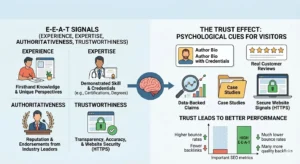
Google officially evaluates content using a quality framework called E-E-A-T, which stands for Experience, Expertise, Authoritativeness, and Trustworthiness. This framework is directly rooted in how humans decide whether to trust a source.
When a visitor lands on your page during the middle of the funnel stage, they are comparing you to competitors. They are asking themselves, silently, “Can I trust this company?”
You build that trust through specific psychological cues. Author bios with credentials, real customer reviews, data-backed claims, case studies, and secure website signals like HTTPS all contribute to perceived authority. A 2023 study by Edelman found that 81 percent of consumers say trust is a deciding factor in their purchase decision.
For SEO, pages with strong E-E-A-T signals earn more quality backlinks, lower bounce rates, and better rankings in competitive search queries. Trustworthiness is not just a moral value. It is a ranking factor.
Trick 4: Leverage the Psychology of Social Proof
Humans are wired to follow the crowd. This is called social proof, and it is one of the most documented psychological phenomena in consumer behavior. When someone is evaluating whether to hire your company or buy your product, they look for evidence that other people have already done it and had a good experience.
Social proof in SEO shows up in multiple ways. Customer testimonials embedded in your landing pages reduce friction. Star ratings in Google search results, known as rich snippets, increase click-through rates by up to 35 percent according to Search Engine Land data. Case studies improve conversion rates because they show results, not just claims.
When you optimize your pages to display structured data markup like review schema, FAQ schema, or product schema, you are helping Google understand your content better while also giving users the trust signals they need to take action.
Trick 5: Use Scarcity and Urgency Strategically
As visitors move deeper into your funnel, the psychological barrier to buying is often fear. Fear of making the wrong choice. Fear of overpaying. Fear of committing too soon.
Scarcity and urgency are psychological tools that help overcome inaction. These are not manipulative tricks. They are honest signals that reflect real business conditions. Limited availability, deadline-based offers, and phrases like “currently serving clients in your area” all create a sense of momentum that nudges hesitant buyers forward.
From an SEO perspective, pages that include time-sensitive language and clear calls to action tend to have higher conversion rates, which improves the overall ROI of your organic traffic. More importantly, when users engage with your page elements such as clicking buttons, scrolling deep, and spending more time, Google’s behavioral signals register your page as highly relevant.
Trick 6: Answer Questions Before They Are Asked
At the bottom of the funnel, people want certainty. They have done their research. Now they have specific objections, concerns, or final questions standing between them and a decision.

FAQ sections are one of the most underused conversion tools in SEO. Strategically written FAQ content targets featured snippet opportunities in Google search, also called Position Zero. These are the answer boxes that appear above regular search results and are increasingly being pulled into Google’s AI Overview feature.
When you anticipate the exact questions a buyer has at the decision stage and answer them clearly, you eliminate doubt and create clarity. Both of these outcomes benefit your reader and your rankings at the same time.
Real example: A home services company that added a 5-question FAQ to each service page saw a 22 percent increase in organic leads within 90 days, simply because users could find specific answers without needing to call or search elsewhere.
Don’t Miss That: Why Zero-Click Searches Are More Important Than You Realize: Data-Driven Insights
Trick 7: Design for the Brain, Not Just the Algorithm
Visual hierarchy, white space, contrasting colors for call-to-action buttons, and mobile-first design are not just aesthetic choices. They are rooted in how the human visual cortex processes a web page in the first three seconds of a visit.
Research found that users read web pages in an F-shaped pattern, scanning across the top, then down the left side. Knowing this, smart SEO professionals place their most important messages, headlines, and conversion elements exactly where the eye naturally travels.
For Google, page experience signals including Core Web Vitals, mobile usability, and loading speed are all ranking factors. But these technical measurements exist because Google is trying to measure something fundamentally human: did this page feel good to use?
When you design for the brain, you naturally optimize for the algorithm too.
Frequently Asked Questions
Q: What is the connection between psychology and SEO?
A: SEO is built on understanding human behavior. Google’s algorithm is designed to surface content that genuinely satisfies human intent, builds trust, and delivers a good experience. Psychology helps you understand what drives those human decisions.
Q: How does search intent affect conversion rates?
A: When your content matches what a user actually wants at their stage of the buying journey, they stay longer, engage more, and are far more likely to take action. Mismatched intent is one of the top reasons traffic does not convert.
Q: What are NLP keywords in SEO?
A: Natural language processing keywords are terms and phrases that are semantically related to your main topic. Using them naturally helps Google understand the full context of your content and match it to a wider range of relevant search queries.
Q: How long should a high-converting SEO article be?
A: For competitive topics, content between 1,200 and 2,500 words tends to perform best in organic search. Length matters less than depth and relevance. Cover the topic thoroughly and answer the questions your audience is actually asking.
Final Thoughts
Converting visitors into buyers is rarely about one magic trick. It is about consistently aligning your content with how people actually think, feel, and decide at each stage of their journey.
The businesses that grow through organic search are not the ones chasing every new algorithm update. They are the ones who take time to genuinely understand their audience, build real trust, and create pages that feel as good to read as they are to find.
If you are ready to build an SEO strategy that goes deeper than keywords and actually drives business results, the team at Webtrack Technologies serves as a web design & development company in the USA across the United States and would be glad to help you take the next step.