
You built a great website. You published blogs. You even hired someone to “do SEO.” But your traffic is flat, your Google rankings keep slipping, and now you’re hearing new buzzwords like AEO and GEO being thrown around at every marketing conference.
Here’s the painful truth: the rules of search changed, and most businesses are still playing by the 2019 playbook.
In 2026, getting found online is no longer just about ranking on page one of Google. It is about showing up in AI-generated answers, voice search results, and geographically targeted searches, all at the same time. If your digital strategy is missing even one of these three pillars, you are leaving a massive chunk of visibility on the table.
This guide breaks down exactly how SEO, AEO, and GEO work individually, why they are more powerful together, and what you can do starting today to improve your search rankings in this new era of intelligent search.
Understanding the Basics (What Are SEO, AEO, and GEO?)
What Is SEO in 2026?
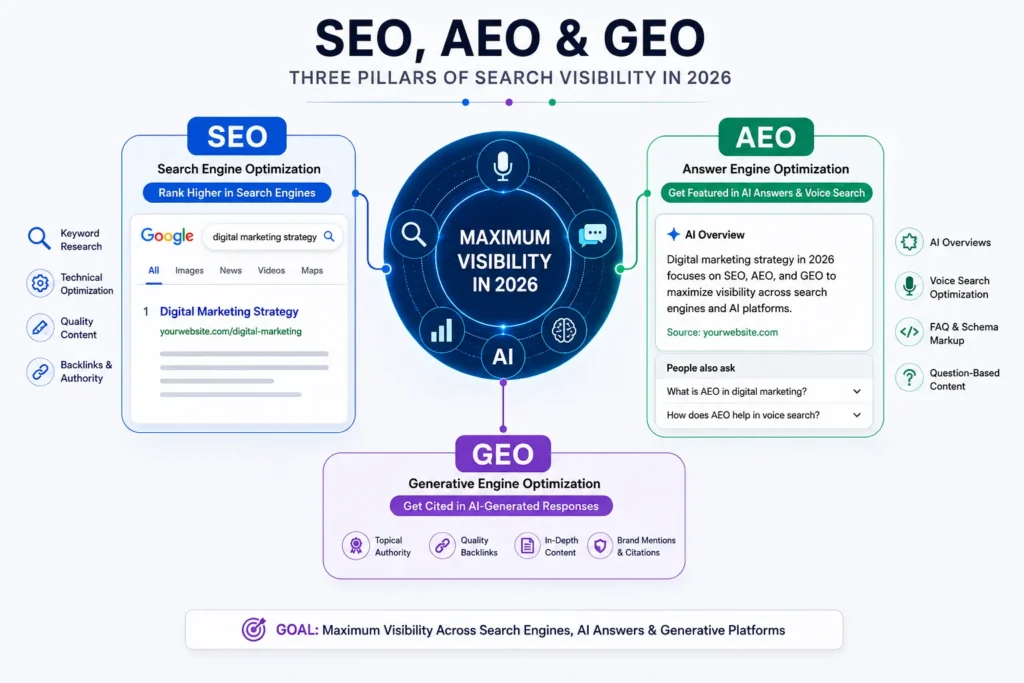
Search Engine Optimization, commonly known as SEO, is the practice of improving your website so that search engines like Google can find, understand, and rank your content. But SEO in 2026 looks very different from what it did even three years ago.
Google’s algorithm has undergone major updates, including the Helpful Content System, the March 2024 Core Update, and the rollout of AI Overviews (formerly known as SGE, or Search Generative Experience). These updates shifted Google’s focus away from keyword-stuffed pages and toward content that genuinely helps people.
Modern SEO now includes technical optimization such as page speed and mobile usability, content quality signals, E-E-A-T (Experience, Expertise, Authoritativeness, and Trustworthiness), semantic search relevance, and structured data markup. Think of SEO as the foundation of your digital presence. Without it, nothing else works as well.
What Is AEO (Answer Engine Optimization)?
Answer Engine Optimization is one of the fastest-growing areas of digital marketing in 2026. AEO focuses on optimizing your content so that AI-powered answer engines, including Google’s AI Overviews, ChatGPT, Perplexity, Bing Copilot, and voice assistants like Siri and Alexa, can pull your content as a direct answer.
When someone types or speaks a question like “What is the best way to speed up my website?”, modern AI systems scan thousands of pages and surface one or two answers that seem the most clear, accurate, and trustworthy. If your content is structured in a way that answers questions directly, uses natural language, and is supported by factual data, you stand a strong chance of being the featured answer.
AEO relies on FAQ schema markup, question-based heading structures, concise paragraph answers, and well-cited factual content. In short, AEO is SEO for the age of artificial intelligence.
What Is GEO (Generative Engine Optimization)?
GEO is the newest term in the trio, and it is arguably the most forward-looking. Generative Engine Optimization refers to the practice of making your content visible inside AI-generated responses, not just traditional search results.
When someone asks an AI tool like ChatGPT or Google Gemini a research question, the engine generates a response by pulling from indexed web content. GEO is about ensuring your brand, product, or service gets cited or referenced inside those AI-generated answers.
GEO involves building topical authority across your niche, earning backlinks from credible sources, producing well-structured long-form content, and ensuring your brand information is consistent across the web. It is also about using natural language patterns that match how large language models interpret and process information.
The Strategy Layer (How These Three Work Together)
The Integrated Search Visibility Framework
Here is where things get interesting. SEO, AEO, and GEO are not three separate strategies. There are three layers of the same goal: being found everywhere a potential customer might be searching.
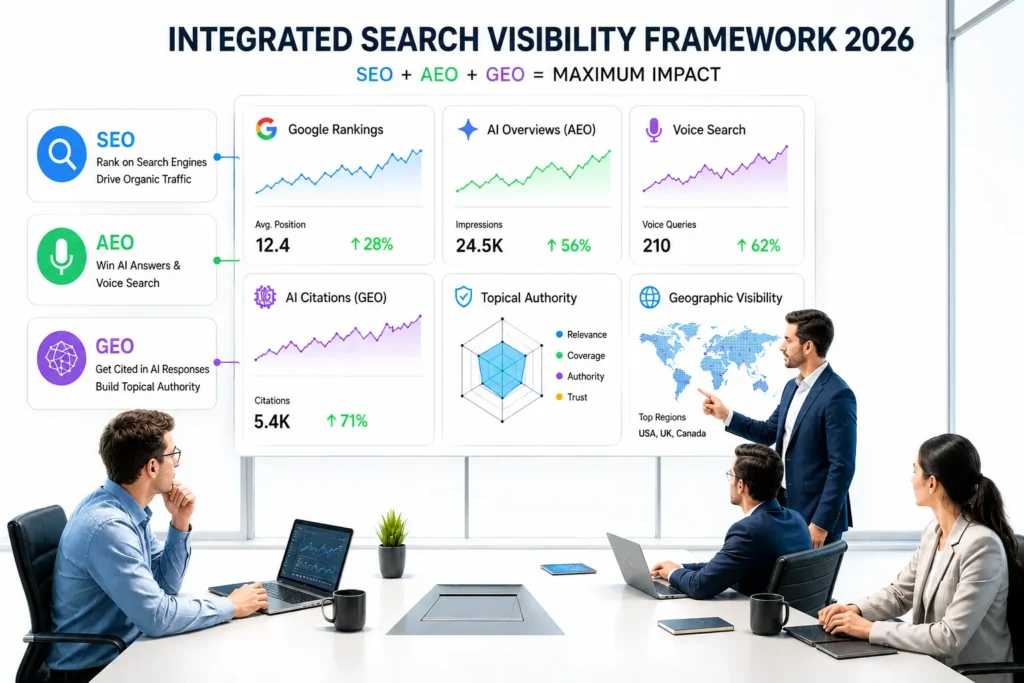
Think of it like a three-legged stool. SEO is the first leg and handles your organic rankings on Google and Bing. AEO is the second leg and captures AI-generated answers and voice search results. GEO is the third leg and ensures your content appears inside AI-generated summaries and research responses. Remove any one leg and the stool falls over.
A practical example: a local business that writes a blog post titled “How to Choose the Right Contractor in the USA” is using SEO by targeting a keyword-rich phrase. If that same post includes a clean FAQ section with question-and-answer formatting and uses FAQ schema, it becomes AEO-ready. And if the content cites industry statistics, links to authoritative sources, and builds topical depth across multiple related posts, it becomes GEO-optimized, meaning AI tools are more likely to reference it when users ask related questions.
NLP and Semantic Search: The Language That Connects All Three
Natural Language Processing, or NLP, is the technology behind how AI systems understand written content. When Google or an AI tool reads your page, it is not just scanning for keywords. It analyzes sentence structure, topic relationships, intent signals, and entity recognition.
This is why semantic SEO matters so much in 2026. Instead of repeating the same keyword phrase fifteen times, your content should include related terms, synonyms, and conceptually connected ideas that help AI systems understand the full context of your page.
For a post about digital marketing strategy, semantically related NLP terms would include things like search intent, organic traffic, click-through rate, SERP features, topical authority, content clusters, keyword cannibalization, anchor text, dwell time, crawlability, indexing, and entity-based search. Notice that these terms are not forced into a sentence. They are naturally part of how a knowledgeable person writes about the subject.
When your content is rich with semantically relevant language, Google’s NLP models are better able to classify your content, match it to relevant search queries, and serve it in AI Overviews.
The Role of E-E-A-T in All Three Systems
Google’s E-E-A-T framework, which stands for Experience, Expertise, Authoritativeness, and Trustworthiness, was originally an SEO quality signal. In 2026, it has become a universal benchmark that influences AEO and GEO performance as well.
AI tools are trained to favor content from sources that demonstrate real expertise. This means your content should reference original data or research, include author bylines with credentials, cite credible third-party sources, and be consistent in quality across your entire site. A site with 200 mediocre posts will almost always be outperformed by one with 40 deeply researched, well-cited articles.
Taking Action (Practical Steps to Combine SEO, AEO, and GEO)
Step 1: Audit Your Current Search Presence
Before you combine these three strategies, you need to know where you stand. Run a technical SEO audit using tools like Google Search Console, Screaming Frog, or Semrush. Look for crawl errors, slow-loading pages, thin content, and broken links. These technical issues are invisible to your readers but very visible to search engines.
Next, check whether any of your existing content appears in Google’s AI Overviews. You can do this by searching your target keywords and seeing if an AI-generated summary appears at the top of the results. If a competitor is showing up there and you are not, that is a signal to restructure your content using AEO principles.
Step 2: Build a Content Cluster Strategy
One of the most effective ways to gain topical authority and satisfy all three systems is through content clustering. This involves creating one comprehensive pillar page on a broad topic, then writing several supporting articles that dive deep into subtopics. All supporting articles link back to the pillar page, and the pillar links to each supporting piece.
For example, a digital marketing agency might create a pillar page called “The Complete Guide to Digital Marketing in 2026,” with supporting posts covering topics like on-page SEO, local SEO for small businesses, how AEO works, and the difference between GEO and traditional SEO. This creates a web of semantically connected content that both Google and AI tools recognize as authoritative coverage of the subject.
Step 3: Optimize Every Page for Question-Based Queries
Voice search and AI-generated answers are driven by natural language questions. People no longer type “best pizza restaurant USA.” They ask, “What is the best pizza restaurant near me that is open right now?”
To capture these queries, structure your content around questions. Use H2 and H3 headings that mirror how your audience would naturally phrase a question. Include a dedicated FAQ section at the bottom of every major blog post. Use schema markup to tag these questions and answers so AI tools can extract them cleanly.
Step 4: Build Citations and Backlinks That AI Systems Trust
Backlinks are still one of the most powerful ranking signals in traditional SEO. But in the context of GEO, citations go beyond links. When credible websites, news outlets, or industry publications mention your brand by name, even without a direct link, AI language models learn to associate your brand with authority in your niche.
Pursue digital PR campaigns, contribute expert quotes to industry publications, get listed in reputable directories, and encourage satisfied customers to leave reviews on Google and Yelp. All of these activities build the trust signals that feed into AI-generated results.
FAQ: Quick Answers for Common Questions
Q: What is the difference between SEO and AEO?
A: SEO focuses on ranking your website in traditional search engine results. AEO focuses on getting your content selected as a direct answer by AI tools and voice assistants.
Q: Does GEO replace traditional SEO?
A: No. GEO builds on top of SEO. Strong technical and content SEO is a prerequisite for effective GEO performance.
Q: How long does it take to see results from AEO?
A: Results vary, but well-structured content with proper schema markup can begin appearing in AI Overviews within four to eight weeks of indexing.
Q: What is topical authority, and why does it matter?
A: Topical authority means your website is recognized as a reliable, in-depth source on a specific subject.
Q: Is voice search still relevant in 2026?
A: Yes. Voice search is growing alongside AI assistant usage.
The Bottom Line: Integrated Search Is the New Standard
The businesses that will dominate search results in 2026 and beyond are not the ones spending the most on ads. They are the ones who understand that SEO, AEO, and GEO are not competing ideas but a single, unified approach to search visibility.
If you want your content to appear in Google’s organic results, inside AI-generated answers, and within the growing ecosystem of intelligent search tools, you need a strategy that addresses all three layers at once. That means technically sound websites, genuinely helpful content, question-based structure, semantic language, and consistent brand authority across the web.
If you are based in the USA and want expert guidance on building an integrated digital presence that works across modern search systems, the team at Webtrack Technologies, a Trusted IT Services Company in the USA, can help you build a strategy designed for where search is heading, not just where it has been.