
So you have a great app idea. Maybe it came to you in the shower, or maybe you spotted a gap in the market that no one else has filled yet. Either way, the first real question that stops most people in their tracks is: How much does it actually cost to build a mobile app?
The honest answer? It depends. But that answer alone is not very helpful. The goal of this guide is to break down every major cost factor in plain English so you can walk into any conversation with a developer or agency feeling informed and confident. Whether you are a startup founder, a small business owner, or a product manager at a growing company, this article will give you a realistic picture of mobile app development costs in 2026.
Why Mobile App Costs Vary So Much
One of the most common frustrations people share is that they get wildly different quotes from different developers for what seems like the same app idea. A basic app might cost $10,000, while a similar-looking app with more complex features could reach $250,000. That is not a scam, it’s simply how software development works. This is why working with a reliable Mobile App Development Company can help you better understand what goes into the pricing and avoid confusion.
The price of a mobile app is driven by dozens of variables including app complexity, platform choice, location of the development team, design needs, and ongoing maintenance requirements. Understanding each of these will help you set a realistic budget and avoid unpleasant surprises later.
Factor 1: App Complexity and Feature Set
This is the single biggest driver of cost. The more features your app has, the longer it takes to build, and time equals money in software development.
Apps generally fall into three complexity levels:
Simple apps include things like basic calculators, flashcard tools, or single-purpose utility apps. These typically have limited screens, no backend server, and no user login. In 2026, a simple app in the US market costs anywhere from $10,000 to $50,000.
Medium complexity apps cover the majority of business apps, e-commerce platforms, booking systems, and apps with user accounts, push notifications, third-party integrations, and a backend. These commonly range from $50,000 to $150,000.
Complex apps include platforms with real-time functionality, AI and machine learning features, live video or audio streaming, complex payment flows, geolocation services, and enterprise-level security. These projects can run from $150,000 to well over $500,000 depending on scope.
Every additional feature, whether it is a chat system, social login, analytics dashboard, or in-app purchase flow, adds both development time and QA testing time.
Factor 2: Platform Choice, iOS, Android, or Both
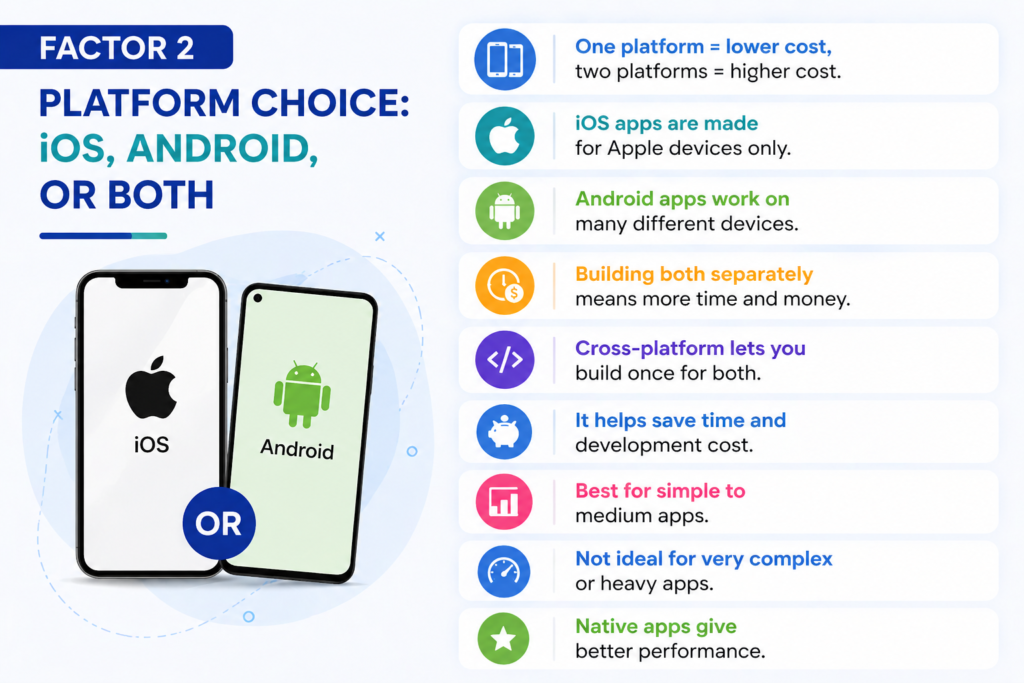
Building for one platform or two makes a significant difference in cost.
A native iOS app is built using Swift or Objective-C and is designed specifically for Apple devices. A native Android app uses Kotlin or Java and is built for the wide range of Android devices in the market. Building native apps for both platforms essentially means building two separate apps, which can nearly double your development cost.
Cross-platform development frameworks like React Native and Flutter have become very popular in 2026 because they allow developers to write code once and deploy it on both iOS and Android. This can reduce development costs by 30 to 40 percent compared to building two native apps. However, cross-platform apps sometimes have performance limitations for highly complex or graphics-intensive use cases.
For most startups and small to mid-size businesses, a cross-platform approach is the smarter financial decision. For apps that demand peak performance, such as augmented reality tools or high-frequency trading platforms, native development is often worth the extra investment.
Factor 3: Design and User Experience
Great design is not optional in 2026. Users have extremely high expectations. An app that looks outdated or feels confusing will be uninstalled in seconds. App store ratings are brutal, and poor user experience is the fastest way to kill retention.
UI/UX design costs depend on the number of screens, the depth of interactivity, custom animations, and whether you need a full design system. A basic design for a simple app might cost $5,000 to $15,000. A polished, research-backed design for a complex app can easily reach $30,000 to $80,000 or more.
Investing in good design upfront reduces the cost of redesigns later, which are notoriously expensive and disruptive to development timelines.
Factor 4: Development Team Location and Hourly Rates
Where your development team is located plays a huge role in the final cost. Hourly rates vary dramatically across different regions of the world.
In the United States and Canada, experienced mobile developers typically charge between $100 and $200 per hour. Agencies in major tech hubs like San Francisco, New York, Austin, and Seattle may charge even more.
Western European developers charge roughly $70 to $150 per hour. Eastern European countries like Ukraine and Poland offer skilled developers at $40 to $80 per hour. South and Southeast Asian countries offer the lowest rates, often $20 to $50 per hour, though quality varies significantly.
Hiring a US-based team often comes with advantages like easier communication, cultural alignment, better accountability, and stronger legal protections. Many companies choose a hybrid model, hiring a US-based project manager and architect while outsourcing execution to lower-cost regions.
Factor 5: Backend Infrastructure and APIs
Most apps do not stand alone. They need a backend server to store data, authenticate users, handle payments, and connect with third-party services.
Backend development costs depend on how complex your database architecture is, how many API integrations you need, and whether you are building a custom backend or using a backend-as-a-service tool like Firebase or Supabase.
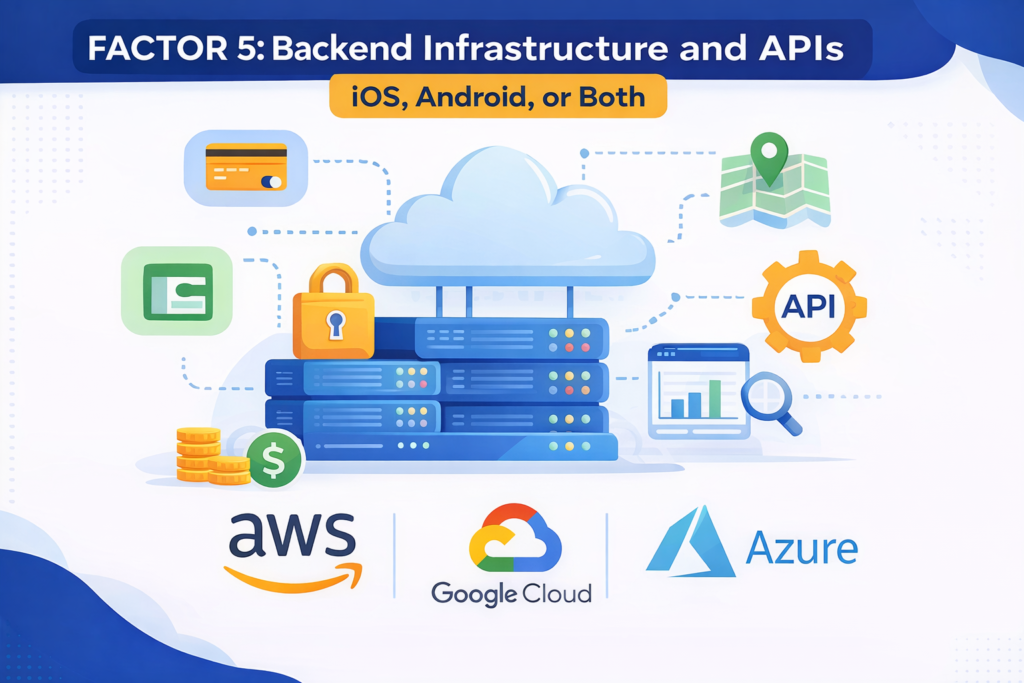
Third-party API integrations such as payment gateways like Stripe or Braintree, mapping services like Google Maps, social login through Facebook or Google, and analytics tools all add to development time and sometimes come with their own licensing or usage fees.
Cloud hosting costs through providers like AWS, Google Cloud, or Microsoft Azure also add to the ongoing operational budget. Expect to pay anywhere from $50 a month for simple apps to several thousand dollars monthly for apps with heavy traffic.
Factor 6: Testing and Quality Assurance
Testing is one area where many first-time app owners try to cut costs, and it almost always backfires. Bugs that slip through to production damage your brand reputation and cost far more to fix after launch than before.
Quality assurance includes manual testing across different devices and operating system versions, automated testing for regression, performance testing, and security testing. For a medium complexity app, expect to allocate 15 to 25 percent of your total development budget to QA.
In 2026, with AI-assisted testing tools becoming more mainstream, some QA tasks are faster and cheaper than they were just a few years ago. But human testers are still essential for real-world usability evaluation.
Factor 7: Post-Launch Maintenance and Updates
App development does not end at launch. In fact, many experienced product teams argue that the work really begins after launch. App stores regularly update their requirements, operating systems release new versions, and user feedback will surface bugs and feature requests you never anticipated.
Most app owners budget 15 to 20 percent of the initial development cost annually for maintenance. For a $100,000 app, that means roughly $15,000 to $20,000 per year in ongoing costs. This covers bug fixes, OS compatibility updates, server maintenance, security patches, and feature enhancements.
Ignoring maintenance is one of the top reasons successful apps decline in ratings and lose users over time.
Hidden Costs Most People Overlook
Beyond the core development budget, there are several expenses that catch first-time app builders off guard.
App store fees are an easy one. Apple charges $99 per year for a developer account, and Google charges a one-time $25 fee. If you plan to sell through the app stores, both take a 15 to 30 percent commission on in-app purchases and subscriptions.
Legal costs including terms of service, privacy policy drafting, and intellectual property registration are often overlooked but important, especially with increasing data privacy regulations in the US and globally.
Marketing and app store optimization are separate budgets entirely. A beautifully built app with zero downloads earns zero revenue. Plan for at least a soft launch marketing budget alongside your development budget.
What Does a Real App Budget Look Like?
Here is a rough illustration to make these numbers concrete.
Imagine a startup building a food delivery app for a specific US city. They want iOS and Android support, user accounts, restaurant listings with search, a real-time order tracker, payment integration, and a simple admin dashboard.
That scope, built by a mid-range US agency, would likely come in at $120,000 to $200,000 for initial development. Design would account for roughly $25,000 of that. Backend infrastructure would be another $20,000 to $30,000. QA and testing would run $15,000 to $25,000. Annual maintenance would be an additional $20,000 to $30,000.
These are not small numbers, but they reflect the real complexity of building a production-grade, competitive mobile product in today’s market.
When Should You Hire a Freelancer vs. an Agency?
Freelancers are a great option for simple apps, early prototypes, or when you have a very tight budget. A single skilled freelancer might charge $50 to $150 per hour and can move quickly on focused work.
Agencies offer broader expertise, dedicated project management, structured QA processes, and more reliable timelines. They are a better choice for complex apps, enterprise projects, or situations where you need a full team of designers, developers, and testers working together.
A third option gaining popularity is building an in-house team, which makes sense if app development is a core and ongoing part of your business model.
Frequently Asked Questions
Q: How much does it cost to build a simple mobile app in the US?
A: A simple single-platform app with basic features typically costs between $10,000 and $50,000 when working with a US-based developer or small agency.
Q: Is it cheaper to build for iOS or Android first?
A: iOS apps are generally slightly faster to develop because there are fewer device variants to test.
Q: What is the cheapest way to build an app?
A: Using cross-platform frameworks like Flutter or React Native, starting with a minimum viable product that includes only core features, and working with developers in cost-effective regions can significantly reduce your initial investment.
Q: How long does app development take?
A: A simple app might take 2 to 3 months. A medium complexity app typically takes 4 to 8 months. Complex enterprise-grade apps can take 12 months or more.
Q: Do I own the code after the developer builds it?
A: This depends entirely on your contract. Always make sure your agreement explicitly states that you retain full intellectual property ownership of the source code. Never assume this is automatic.
Q: How much does app maintenance cost per year?
A: Most teams budget 15 to 20 percent of the original development cost annually. For a $100,000 app, expect to spend $15,000 to $20,000 per year on upkeep.
Making a Smart Decision for Your App Budget
Building a mobile app is a significant investment, but it is one that can deliver massive returns when done right. The most important step you can take before talking to any developer is to clearly define your app’s core value proposition, target audience, and must-have features. The more clarity you have, the more accurate your quotes will be and the less money you will waste on scope changes mid-project.
Start with a minimum viable product. Get it in users’ hands. Gather real feedback. Then invest in expanding features based on what your actual users want rather than what you imagined they might want.
If you are based in the US and looking for a web design & development company in USA to help you navigate complex decisions, the team at Webtrack Technologies works with businesses across the country to plan, design, and build mobile apps that fit both their vision and their budget. Reaching out for an initial consultation is a low-pressure way to get a clearer picture of what your specific idea would actually cost to build.
The right app, built the right way, is one of the best business investments you can make in 2026.