Have you ever opened an app and felt like it just gets you? It shows you the right content, predicts what you need before you ask, and adapts to your habits without any manual setup. That is not a coincidence. That is the power of a personalized AI model working quietly in the background.
Today, millions of users in the United States are shifting away from one-size-fits-all digital tools. They want apps that learn, adapt, and respond to who they are, not just what they click. This shift is reshaping how mobile app developers think about design, user experience, and long-term engagement.
If you are a business owner, a startup founder, or a tech decision-maker trying to understand why personalized artificial intelligence is becoming the core of modern mobile applications, this article is written for you.
The Problem With Generic Mobile Apps
Most traditional mobile apps are built around a fixed experience. Every user sees the same layout, the same recommendations, and the same feature flow. This approach made sense ten years ago when smartphones were still a novelty and expectations were low.
But user behavior has changed dramatically. According to data from Statista, the average American spends over four hours a day on their mobile device. With so much screen time, users have become sharp. They notice when an app does not understand them. They uninstall quickly. They leave one-star reviews. They move on.
Generic apps fail because they treat every user as the same person. A 22-year-old college student in Austin, Texas, and a 50-year-old business executive in Chicago, Illinois, have completely different needs, habits, and attention spans. Serving them identical content is the digital equivalent of handing everyone the same meal at a restaurant without asking about preferences or allergies.
This is exactly where modern mobile app development is evolving, using personalised AI models to create tailored experiences that match individual user behaviour and expectations.
What Is a Personalized AI Model in Mobile Apps?
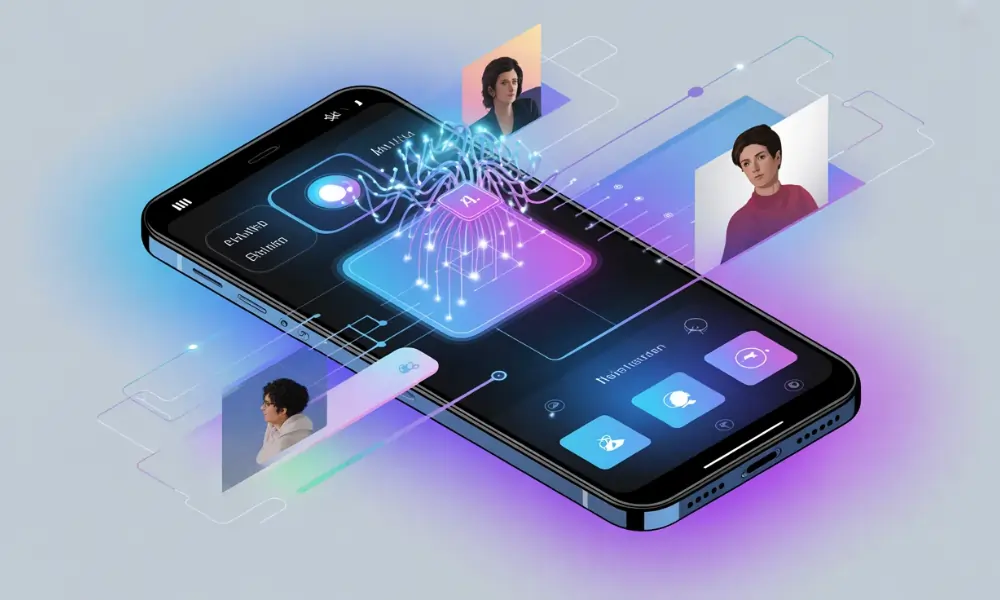
A personalized AI model is a machine learning system trained to understand individual user behavior, preferences, and patterns. Instead of using a static rulebook, these models continuously learn from real interactions and update their responses accordingly.
Think of it like this. When you use a music streaming app, and it starts suggesting songs you actually enjoy, that is personalized machine learning at work. When a fitness app adjusts your workout plan based on your recovery data, that is adaptive AI. When an e-commerce app shows you products that match your past browsing in a way that feels almost intuitive, that is behavioral AI modeling driving the experience.
These systems rely on a combination of technologies, including natural language processing, collaborative filtering, deep learning, predictive analytics, and real-time data pipelines. Together, they create an experience that feels human, even though it is entirely automated.
How Personalized AI Models Are Driving Mobile App Innovation
Smarter User Onboarding
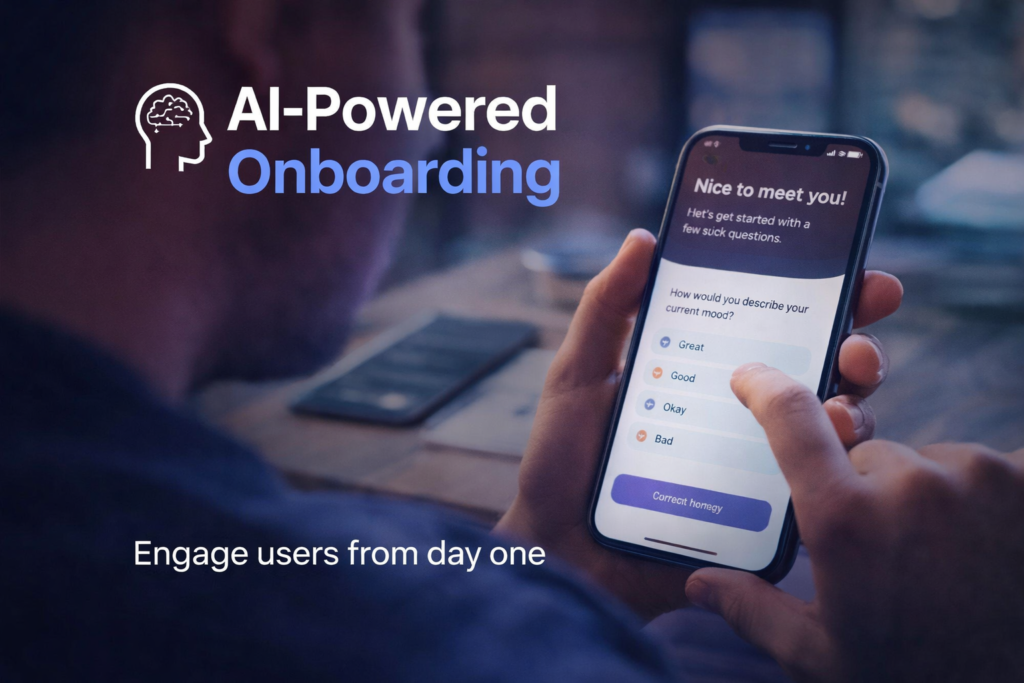
One of the biggest drop-off points in any mobile app is the onboarding process. Studies from Localytics show that roughly 25 percent of apps are only used once after being downloaded. Personalized AI solves this by dynamically adjusting onboarding flows based on user input, location, device type, and behavioral signals.
For example, a mental wellness app might ask a few quick questions at setup and then immediately personalize the dashboard, the notification schedule, and the content themes. The user feels understood from day one, and that emotional connection builds retention.
Context-Aware Recommendations
Recommendation engines powered by AI are now the backbone of apps across retail, media, healthcare, and finance. But the next generation of these systems goes beyond simple “users who liked this also liked that” logic.
Modern personalized AI models consider time of day, geographic location, recent activity, emotional signals from text input, and even device battery levels to serve context-aware recommendations. A food delivery app might push breakfast options at 8 AM in New York and suggest late-night snack deals past 10 PM in Los Angeles. That level of context sensitivity was not possible without intelligent AI personalization.
Adaptive User Interfaces
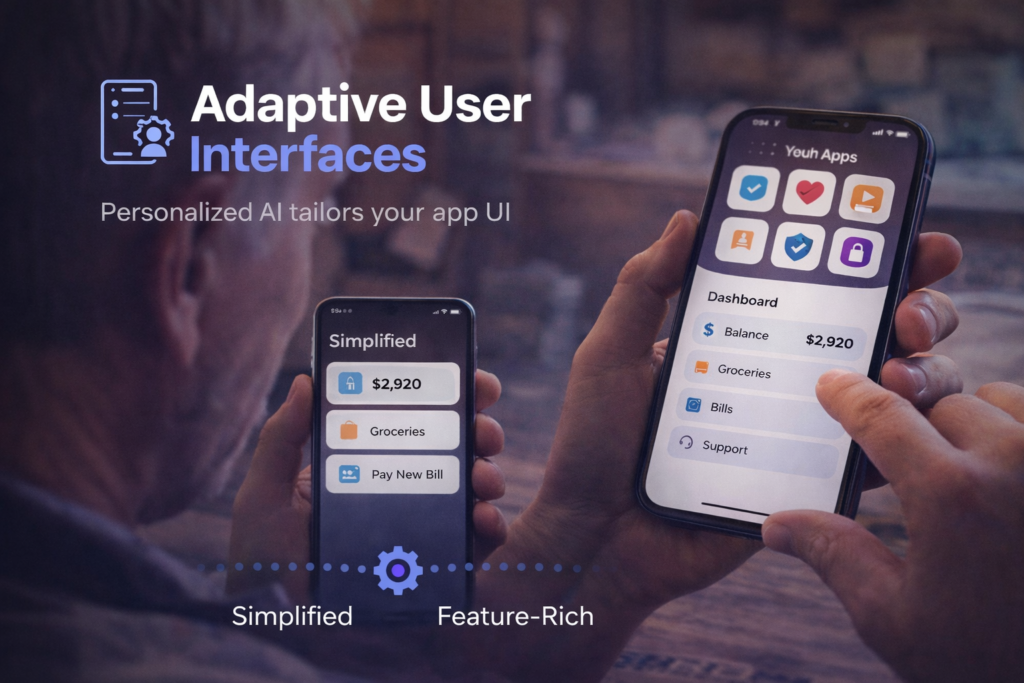
The interface of a mobile app does not have to be rigid. Personalized AI can now rearrange menus, highlight features most relevant to a specific user, and even change the visual complexity of an interface based on how tech-savvy a user appears to be.
This adaptive, perfect UX AND UI approach reduces cognitive load and makes apps feel more intuitive. Senior users see simplified screens. Power users get advanced features surfaced automatically. Everyone gets an experience tailored to their comfort level.
Predictive Behavior and Proactive Assistance
One of the most exciting developments in mobile AI is proactive assistance. Instead of waiting for a user to make a request, the app anticipates the need and delivers value before the user even realizes they wanted something.
Google Maps does this by suggesting your commute route before you open the app. Spotify does it with Daily Mix playlists. Banking apps do it by flagging unusual spending before the user notices. This kind of predictive AI behavior is only possible when a personalized model has learned enough about individual patterns to make accurate predictions.
Real-Time Personalization at Scale
One misconception is that personalization is only achievable for small user bases. In reality, companies like Netflix and Amazon have proven that real-time AI personalization can scale to hundreds of millions of users simultaneously. The infrastructure behind this includes cloud computing, edge AI, federated learning, and distributed data processing.
For mobile app developers, this means that even a startup with a growing user base can implement personalized AI features using cloud-based machine learning platforms like Google Cloud AI, AWS SageMaker, or Azure Machine Learning.
Real-World Examples That Prove the Point
Duolingo uses AI personalization to adjust lesson difficulty, pacing, and reminders based on individual learning curves. Users who struggle with a concept get extra practice automatically. Users who master quickly move faster. The result is a 4.7-star rated app with some of the strongest retention numbers in the education tech space.
Nike Training Club personalizes workout plans using fitness data, personal goals, and historical performance. The AI model does not just suggest generic routines. It creates an adaptive training experience that evolves with the user.
Stitch Fix, a fashion app, uses a blend of human stylists and AI personalization to deliver clothing boxes tailored to individual style profiles. Their AI model analyzes over 100 data points per user, including feedback from previous orders, social media activity, and seasonal trends.
These are not experimental use cases. These are mainstream applications driving billions in revenue because they made personalization a core product feature, not an afterthought.
The Technology Stack Behind Personalized AI in Mobile Apps
For those wondering what makes all of this work under the hood, here is a simplified breakdown.
Data Collection Layer: The app gathers behavioral data such as clicks, swipes, session duration, and search history. This is done with user consent and in compliance with privacy regulations like CCPA in California.
Feature Engineering: Raw data is transformed into meaningful signals. For example, “user opened the app three times between 7 PM and 9 PM on weekdays” becomes a behavioral feature that the model learns from.
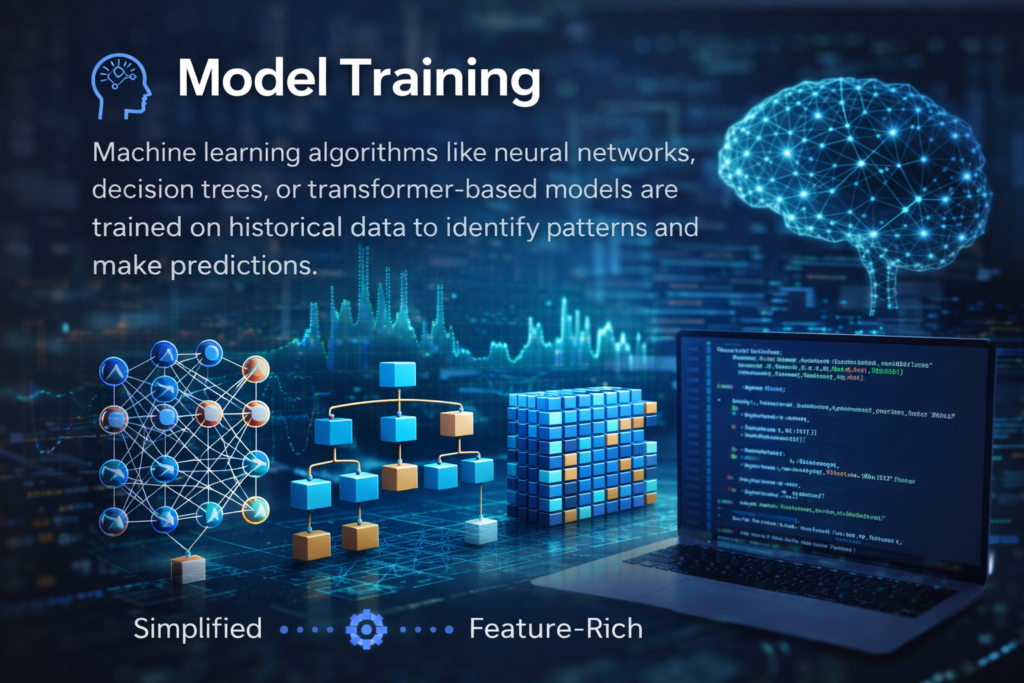
Model Training: Machine learning algorithms like neural networks, decision trees, or transformer-based models are trained on historical data to identify patterns and make predictions.
Inference Engine: The trained model is deployed and runs in real time, making personalized decisions every time a user interacts with the app.
Feedback Loop: User actions after a recommendation, such as clicking, ignoring, or dismissing, feed back into the model to improve future predictions.
This continuous loop of learning and adapting is what separates a truly intelligent app from one that simply has a few smart features bolted on.
Challenges Developers Face With AI Personalization
Implementing personalized AI is not without challenges. Cold start problems occur when there is not enough data about a new user to make accurate recommendations. Privacy concerns are real, especially as users become more aware of how their data is used. Bias in training data can lead to unfair or inaccurate personalization for certain user groups.
Responsible AI development requires transparency, clear data consent policies, bias auditing, and a commitment to user privacy. The best apps in this space are not just technically excellent. They are ethically designed.
When Should Your Business Invest in Personalized AI for Its Mobile App?
If your app has more than a few thousand active users and you are seeing high churn, low session depth, or poor engagement metrics, personalized AI could be the strategic upgrade your product needs.
Signs that your app is ready for AI personalization include a growing dataset of user behavior, a clear business case for deeper engagement, a development team with access to machine learning expertise or cloud AI tools, and a commitment to responsible data practices.
You do not need to build everything from scratch. Many businesses start with pre-built personalization SDKs and APIs and gradually build more custom models as their user base grows and data matures.
Frequently Asked Questions
Q: What is personalized AI in mobile apps?
A: Personalized AI uses machine learning to adapt apps based on user behavior, delivering tailored content and experiences.
Q: How does AI personalization improve user retention?
A: When users feel an app understands their needs and preferences, they are more likely to return. Personalized experiences reduce friction, increase satisfaction, and create an emotional connection with the product.
Q: Is personalized AI only for large tech companies?
A: No. Thanks to cloud-based AI platforms and open-source machine learning tools, businesses of all sizes can implement personalized AI features in their mobile apps.
Q: What data does personalized AI use?
A: AI personalization systems typically use behavioral data such as app usage patterns, click history, search queries, and session frequency.
Q: How long does it take to build a personalized AI model for an app?
A: It depends on the complexity. A basic recommendation engine can be built in weeks using cloud AI services.
Q: Does personalized AI raise privacy concerns?
A: Yes, and those concerns are valid. Responsible developers address this through clear data consent flows, anonymization techniques, and compliance with regulations like CCPA and GDPR.
What This Means for the Future of Mobile Apps
The direction is clear. Mobile apps that do not offer intelligent, personalized experiences will lose users to those that do. The competitive advantage no longer lies only in having the most features or the prettiest design. It lies in building an app that knows its users and grows smarter over time.
Personalized AI is becoming the standard, not the exception. From healthcare apps that adapt to patient needs in cities like Houston and Phoenix, to fintech platforms serving diverse communities across Florida and New York, the transformation is happening across every industry and every state.
Ready to Build Smarter? Let’s Talk.
If your business is ready to explore what personalized AI can do for your mobile app, working with an experienced technology partner makes all the difference. Webtrack Technologies helps businesses across the United States design and develop AI-powered mobile applications that are built to learn, adapt, and grow with their users.
Whether you are just starting to explore the possibilities or ready to take your existing app to the next level with Web Design & Development services, reaching out to a team that understands both the technical and business sides of mobile AI innovation is a smart first step.
The future of mobile belongs to apps that understand their users. Personalized AI is not just a feature. It is the foundation.