

When most businesses think about geographical targeting and location-based marketing strategies, they often fall into a common trap. They assume that the volume of search prompts or user inquiries in a particular region should determine where they invest their resources and marketing efforts. This conventional thinking, however, can lead to missed opportunities and wasted budget allocation. Your GEO strategy should be built on much more than just prompt volume metrics.
The reality is that prompt volume tells only part of the story. It shows you where people are searching, but it doesn’t reveal where your business can genuinely succeed, where your target audience actually needs your solutions, or where competitive pressures might make entry impossible. A high-volume location might seem attractive on paper, but it could be saturated with competitors, have lower conversion rates, or simply not align with your business model and capabilities.
Let’s explore why prompt volume should not be your primary deciding factor when developing a geographical expansion or targeting strategy, and what metrics and considerations actually matter for sustainable growth especially when you understand that GEO differs from SEO.
The Misconception About Prompt Volume And Location Targeting
What Exactly Is Prompt Volume?
Prompt volume refers to the total number of searches, queries, or user interactions happening in a specific geographic area. Tools that track search behavior often highlight regions with thousands or millions of monthly searches related to your industry or services. On the surface, this seems like valuable information. Higher numbers suggest more people are looking for what you offer, right?
Not necessarily. Prompt volume is a measurement of search interest and user activity in a region, but it’s fundamentally different from actual business opportunity. High search volume in a location doesn’t automatically translate to customers, sales, revenue, or market viability for your specific business offering.
The Danger of Volume-Only Decision Making
Many business owners and marketing teams make the critical error of using prompt volume as their primary metric for geographical targeting. They see a region with ten thousand monthly searches related to their industry and assume that’s where they should focus. They allocate budget, hire staff, develop marketing campaigns, and commit resources based almost entirely on these numbers.
What happens next is often disappointing. Despite high search volume, conversion rates remain low. Customer acquisition costs spiral upward. The market proves far more competitive than expected. Local preferences differ dramatically from what the company anticipated. What looked like a golden opportunity on paper becomes a drain on resources and profitability.
The Volume Paradox
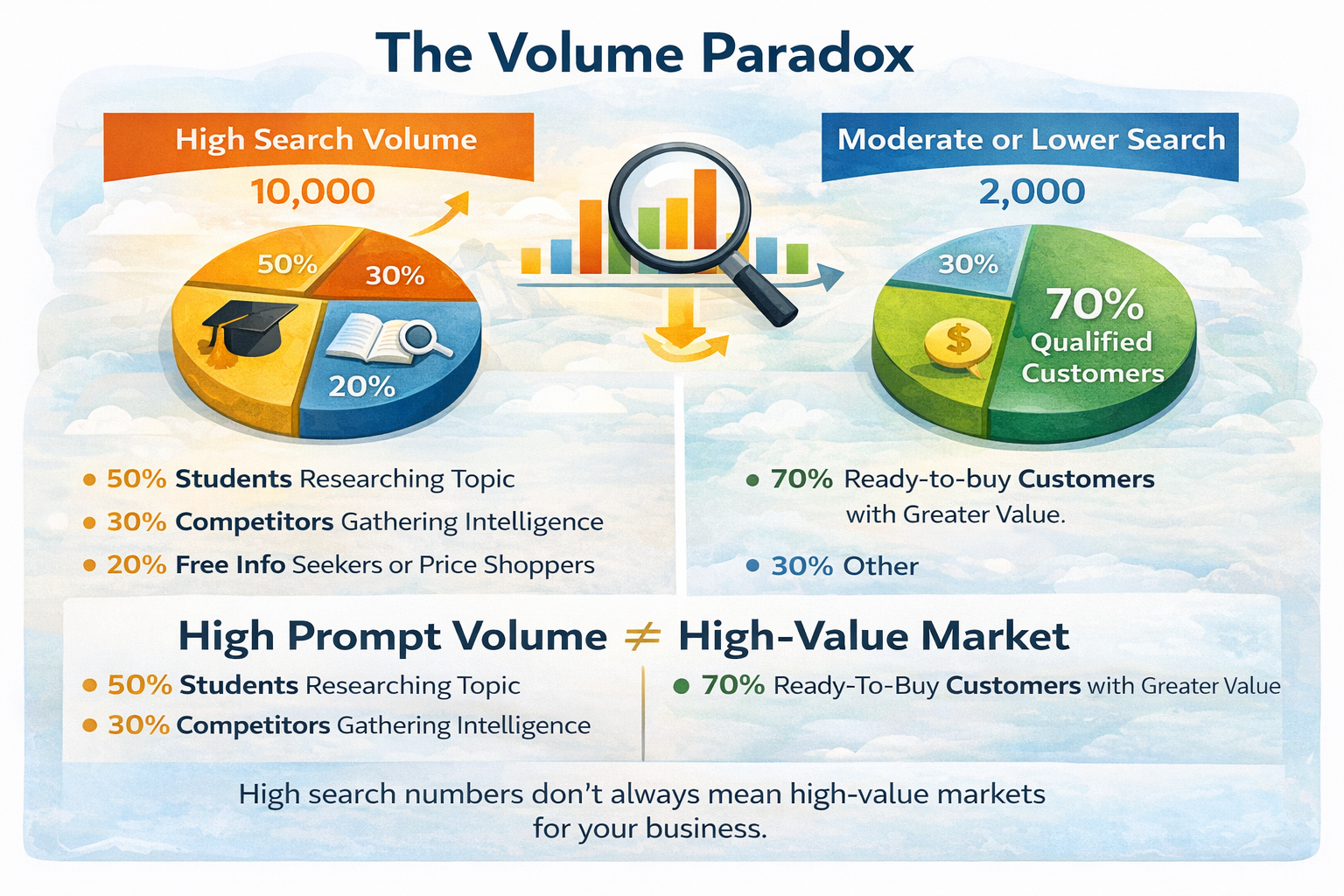
This is what we call the volume paradox. Some of the most valuable markets for your business might have moderate or even lower search volumes. Conversely, regions with impressive search numbers might be populated by searchers who are simply browsing, comparing options, or seeking free information rather than ready to purchase.
Think about it this way: ten thousand people searching for a service doesn’t mean ten thousand potential customers. Some are students researching the topic. Some are competitors gathering intelligence. Some are looking for the cheapest possible option and will never be your customer regardless of your offering. Others are in the awareness stage and won’t be ready to buy for six months or a year.
The Real Factors That Should Drive Your GEO Strategy
Market Maturity and Economic Conditions
Your geographical strategy should begin with understanding the economic characteristics and market maturity of different regions. This means looking at factors like regional income levels, business spending capacity, industry presence, and economic growth patterns.
A location might have lower absolute search volumes but far higher purchasing power and willingness to invest. Markets in certain areas of the United States might show smaller search populations but greater individual spending capacity. Economic regions with established industries related to your services often represent more stable opportunities than high-volume areas experiencing temporary search spikes.
Competitive Landscape Analysis
Before choosing where to expand or focus your efforts, conduct a thorough competitive analysis for each geographic region you’re considering. Who are your competitors? How established are they? What market share do they control? How are they positioning their services?
High prompt volume sometimes indicates a crowded marketplace where customer acquisition becomes expensive and brand differentiation becomes difficult. Lower volume areas might offer less competition and easier paths to market leadership. The competitive intensity in a region is far more predictive of your potential success than raw search numbers.
Alignment With Your Target Audience
Your ideal customer exists in specific locations based on demographic, psychographic, and behavioral characteristics that have nothing to do with search volume. Where do your best existing customers live? Where do people with the right income levels, job titles, industry affiliations, and buying behaviors concentrate?
Geographical targeting should follow your customer profile, not prompt volume trends. If your business serves enterprise technology companies, you should target regions with high concentrations of technology companies and tech professionals. This targeted approach often outperforms spreading resources across high-volume regions with mismatched audiences.

Infrastructure and Operational Feasibility
Can your business actually operate successfully in the regions you’re considering? If you’re a service-based business requiring local presence, do you have the infrastructure, staffing, and logistics to serve that market effectively? If you’re an ecommerce business, are there shipping limitations, regional regulations, or delivery challenges?
A region with massive search volume might be operationally complex or expensive for your business model. Conversely, regions with moderate search activity might offer excellent operational feasibility and cost efficiency that makes them highly profitable despite lower volume numbers.
Conversion Rates and Customer Quality
Different geographical regions produce vastly different conversion rates and customer quality metrics. One location might convert at five percent while another converts at two percent, despite both having significant search volumes. Customer lifetime value varies dramatically by region based on local economic conditions, customer expectations, service standards, and market dynamics.
Always evaluate historical conversion data and customer quality metrics by location rather than relying on top-line search volume figures. A region with lower prompts but higher conversion rates and better customer value will almost always be more profitable than a high-volume area with poor conversion metrics.
Building A Data-Driven GEO Strategy
Moving Beyond Single Metrics
Effective geographical strategy requires abandoning reliance on any single metric, including prompt volume. Instead, develop a comprehensive scoring system that considers multiple factors and weights them appropriately for your business model.
This scoring system should include search volume as one input among many, but not as the dominant factor. Include competitive intensity metrics, cost per acquisition by region, conversion rates, average customer value, operational costs, market maturity indicators, and alignment with your target audience profiles.
Creating Your Geo Scorecard
Start by identifying all geographic regions relevant to your business. This might be states across the United States, metropolitan areas, or even specific neighborhoods depending on your market scope. For each region, gather data on multiple dimensions.
Document the current search volume for your core keywords and service offerings. Research the competitive landscape and identify key players. Analyze demographic data to see how well the population aligns with your ideal customer. Look at historical conversion data if available. Assess operational requirements and costs. Evaluate economic growth trends and market maturity.
Then assign weights to each factor based on what actually drives success in your business. For some companies, conversion rate might be the most important factor. For others, operational feasibility or customer lifetime value might dominate the scoring. This weighted approach prevents high prompt volume from overwhelming more important considerations.
Testing and Validation
Before committing significant resources to any geographical market, conduct small tests to validate your assumptions. Launch targeted campaigns with modest budgets. Measure actual conversion rates, customer acquisition costs, and customer quality metrics. Let real-world performance guide your decisions rather than relying on projections and assumptions based on search volume.
Many successful geographical expansions start small in moderate-volume markets that show strong test results. These initial successes then inform larger investments. This approach protects your budget and allows data-based learning before major commitments.
Learning From Real-World Examples
The Premium Service Example
Consider a high-end consulting firm serving large enterprises. National search volume analysis might point to major metropolitan areas with millions of tech workers and high business activity. These areas show impressive prompt numbers.
However, the firm discovers through analysis that many searches in these major markets come from small businesses, freelancers, and price-conscious buyers who represent poor fit for their premium positioning. Meanwhile, smaller metropolitan areas with lower search volumes contain higher concentrations of Fortune 500 companies and enterprise decision makers. The firm’s test campaigns in these lower-volume regions show three times higher conversion rates and significantly higher deal values.
By moving away from prompt volume as the primary driver, this consulting firm identifies more profitable markets and achieves better results with lower marketing spend.
The Local Service Business Example
A plumbing and HVAC service company initially focused expansion efforts on major cities with high search volumes for plumbing services. They discovered, however, that these saturated markets forced them to compete heavily on price. High customer acquisition costs combined with price competition made profitability difficult.
Through geographical analysis, they identified secondary markets with moderate search volumes but less competition and higher service prices. These smaller markets, which search volume metrics would have deprioritized, actually became their most profitable locations. Lower competitive intensity allowed them to maintain healthy margins while maintaining acceptable customer acquisition costs.
The B2B Software Example
A B2B software company initially assumed that regions with the highest search volume for their core keywords represented the best expansion targets. They invested in marketing efforts concentrated in these high-volume areas.
Analysis of actual customer success revealed that regions with more moderate search volumes but higher concentrations of their target industry verticals produced much better customer outcomes, lower churn rates, and higher expansion revenue. These regions also showed more aligned search intent, with more searches coming from actual buying organizations rather than casual researchers.
Implementing Geographical Targeting Without Volume Bias
Step One: Define Your Actual Target Market
Before examining any geographical data, clearly define your ideal customer profile. Who are they? What industries do they work in? What income ranges matter? What geographic characteristics matter beyond just location? What specific problems does your business solve for them?
This customer definition becomes your foundation for geographical targeting. Instead of asking where people are searching, ask where your ideal customers actually live and work.
Step Two: Map Customer Concentration
Research and map where your target audience actually concentrates. Use labor statistics, industry reports, demographic databases, and business registries to identify regions with high concentrations of your ideal customers. This geographical mapping of your target market provides a much stronger foundation than search volume alone.
Step Three: Evaluate Market Conditions
For each region where your target audience concentrates, evaluate the market conditions. How much competition exists? What are typical service prices and customer expectations? What operational challenges might you face? What are the cost structures for serving this market effectively?
This evaluation reveals where you can succeed not just in reaching customers, but in actually serving them profitably.
Step Four: Test Small Before Scaling
Launch pilot programs in one or two markets that show strong potential based on your analysis. Keep these tests modest in scope and investment. Measure actual results carefully, tracking conversion rates, customer acquisition costs, customer quality metrics, and profitability.
Let six to twelve months of real-world data guide your next decisions rather than relying on initial assumptions, regardless of how compelling the prompt volume numbers seemed.
Step Five: Scale What Works
Based on test results, prioritize geographical expansion into markets where you’ve validated strong performance. Use successful markets as templates for expansion into similar markets with comparable characteristics. Always remember that markets that worked might not look like the highest-volume options you initially considered.
Common Questions About Geographical Strategy
Q: Is search volume completely irrelevant to geographical strategy?
A: No, it still matters because it shows demand. But it shouldn’t be your main decision factor combined with conversion rates, competition, and how well the market fits your ideal customer.
Q: What if I’m a brand new business with no historical data?
A: Focus on understanding your target audience and where they are located. Study competitors, use industry and demographic data, and test your offer in smaller or less competitive markets before scaling.
Q: How do I know if a region is truly competitive or just high volume?
A: Look beyond volume, analyze how many competitors exist, their pricing, and how saturated the market is. Customer interviews and market research help reveal real demand vs. overcrowding.
Q: Can prompt volume ever be a good primary indicator?
A: Sometimes, but mostly for simple, high-demand consumer services. For most businesses, especially B2B or specialized services, customer fit and competition matter more.
Q: Should I completely ignore my current high-volume markets?
A: No. Keep serving them if they’re working. Just don’t rely only on volume when deciding where to expand next.
Q: How often should I reevaluate my geographical strategy?
A: At least once a year, or more often if the market changes. Continuously use performance data to adjust your approach.
Final Thoughts
Your geographical strategy deserves better than a simplistic reliance on prompt volume metrics. The most successful businesses build geo strategies on multiple factors: target customer concentration, competitive landscape, market maturity, operational feasibility, and validated performance metrics.
High search volume can seem attractive, but it often indicates crowded markets, expensive customer acquisition, and fierce competition. Meanwhile, regions with moderate or lower search volumes frequently offer better profitability, less competition, and stronger customer fit when they’re selected based on proper market analysis.
Start building your geographical strategy around your ideal customer, validate your assumptions with small tests, and let real-world performance data guide your expansion decisions. This approach requires more work than simply chasing high-volume regions, but the results demonstrate dramatically better returns on your geographical investment.
If you’re looking to refine your geographical targeting approach or need help analyzing market opportunities in specific regions, consider consulting with professionals who understand how to move beyond surface-level metrics to real market intelligence. Webtrack Technologies is Web Design & Development Agency in USA specializes in helping businesses develop sophisticated geographical strategies that deliver sustainable growth.
The geographical markets that matter most aren’t always the ones with the most searches. They’re the ones where your ideal customers live, where competition is manageable, where you can operate efficiently, and where your offering delivers genuine value. By shifting your focus from prompt volume to these fundamentals, you position your business for geographical success that endures.
Remember that building a geo strategy without proper analysis is like choosing where to buy property based only on foot traffic, without considering location, infrastructure, market conditions, or resale value. The visible metrics don’t tell the complete story. Take the time to understand the actual market fundamentals, and your geographical expansion will deliver results far exceeding what volume-focused approaches achieve.